

What Is Currency Debasement? Meaning, Causes, Examples, and Effects
Have you ever wondered why $100 today buys less than it did 20 years ago?
The answer is partly related to inflation and the declining purchasing power of money. Another term frequently used in discussions about the value of money is currency debasement.
Currency debasement has existed for thousands of years. In the past, governments reduced the amount of gold or silver in coins. Today, the term is often used to describe the gradual erosion of a currency's purchasing power.
But what exactly is debasement, how does it work, and why does it matter to investors and forex traders?
Let's explore the meaning of currency debasement, its causes, historical examples, and potential effects on the economy.
What Is Currency Debasement?
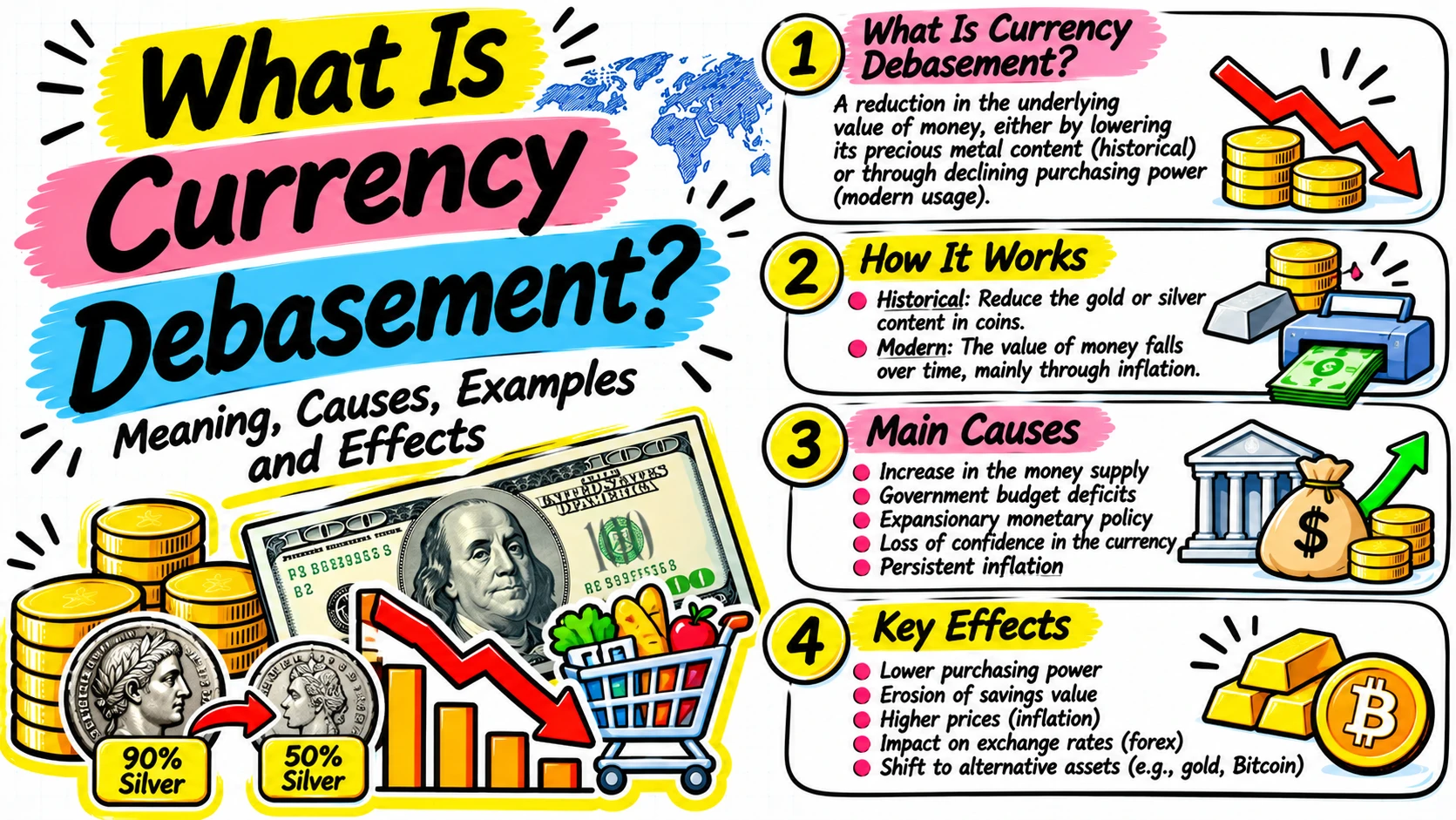
Currency debasement is the reduction in the underlying value of money.
Historically, debasement occurred when governments reduced the precious metal content of coins while maintaining their stated monetary value.
For example, a silver coin that originally contained 90% silver might later be produced with only 50% silver.
Although the coin retained the same denomination, its precious metal content had decreased.
In modern economies, most currencies are no longer backed by a fixed amount of gold or silver.
Instead, they operate under a fiat monetary system.
Today, the term currency debasement is often used more broadly to describe a decline in money's purchasing power, particularly when associated with monetary expansion and persistent inflation.
However, not every increase in the money supply causes inflation, and not every episode of inflation is caused by monetary expansion.
In simple terms, currency debasement means that money becomes less valuable, either through a reduction in its intrinsic metal content or, in modern usage, through erosion of purchasing power.
How Does Currency Debasement Work?
Currency debasement has taken different forms throughout history.
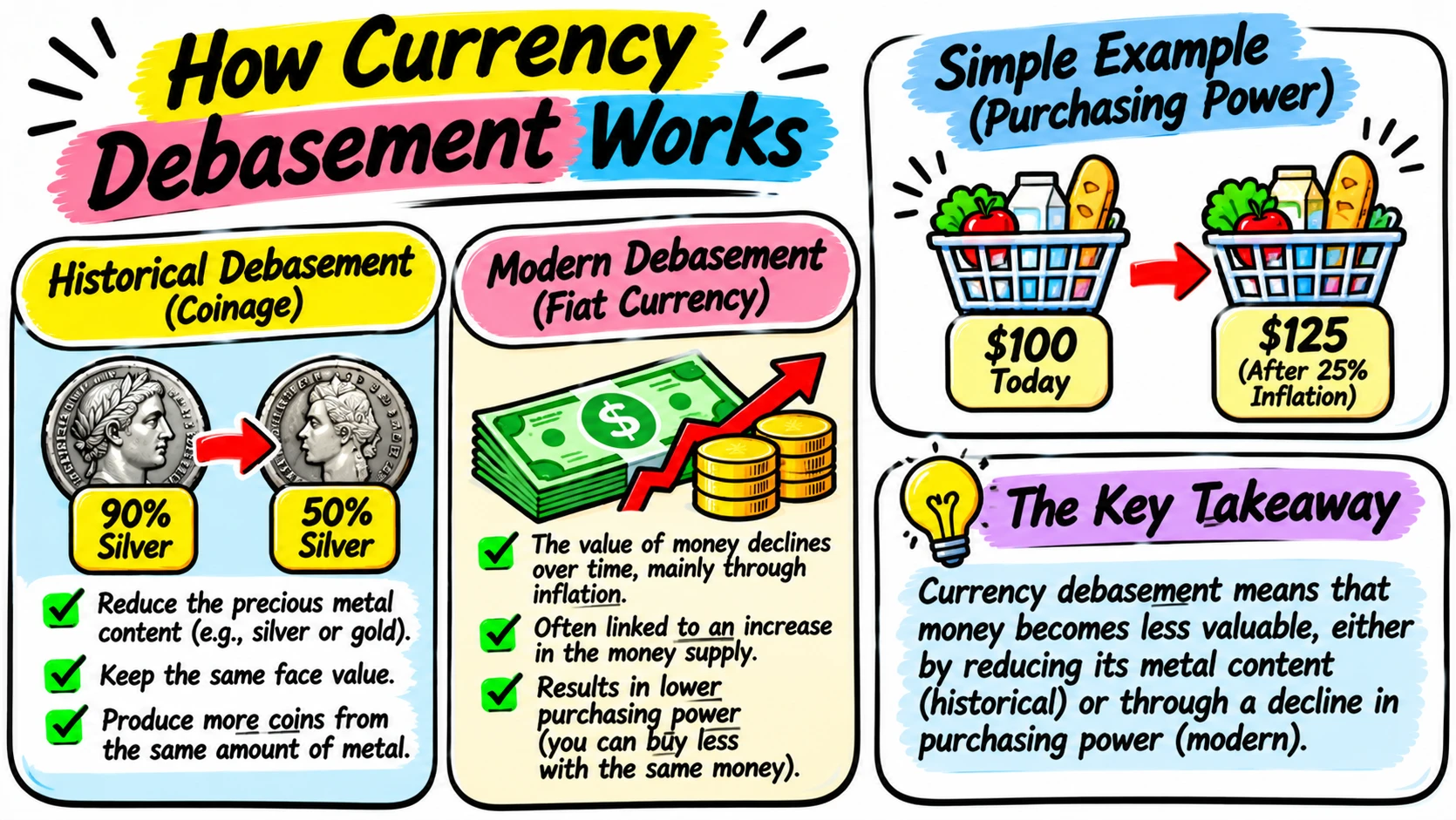
1. Historical Debasement: Reducing Gold or Silver Content
Before modern paper currencies became widespread, many monetary systems used coins made from precious metals.
Governments could increase the number of coins produced from a fixed amount of silver or gold by mixing in cheaper metals.
For example:
-
Original coin: 90% silver.
-
Debased coin: 50% silver.
-
Face value: Unchanged.
-
Precious metal content: Reduced.
This allowed governments to produce more coins using the same quantity of precious metal.
However, widespread debasement could eventually weaken confidence in the currency and contribute to rising prices.
2. Modern Debasement: Declining Purchasing Power
Modern currencies such as the US dollar, euro, and Japanese yen are fiat currencies.
Their value does not depend on a fixed amount of precious metal.
Instead, purchasing power depends on factors including inflation, monetary policy, economic productivity, and confidence in the currency.
For example, imagine that a basket of everyday goods costs $100 today.
If the overall price level increases by 25%, that same basket would cost $125.
Your original $100 would no longer purchase the full basket.
This is an example of declining purchasing power, often described as monetary erosion or, more loosely, modern currency debasement.
What Causes Currency Debasement?
Several economic and monetary factors can contribute to the declining value of money.
1. Excessive Money Supply Growth
One commonly discussed cause is rapid expansion of the money supply.
When the amount of money circulating in an economy grows significantly faster than the production of goods and services, inflationary pressure may increase.
For example, if consumers have more money to spend but businesses cannot increase production sufficiently, prices may rise.
However, money supply growth does not automatically produce an equivalent increase in consumer prices.
The outcome also depends on money demand, spending behavior, production, and broader economic conditions.
2. Government Budget Deficits
Governments sometimes spend more money than they collect through taxes.
This creates a budget deficit.
Deficits are generally financed through borrowing, but under certain monetary arrangements, government spending may also be supported by money creation.
Persistent fiscal pressures can increase concerns about inflation, monetary stability, and future currency value.
However, government borrowing alone does not necessarily constitute currency debasement.
3. Expansionary Monetary Policy
Central banks may lower interest rates or purchase financial assets to support economic activity.
These policies can encourage borrowing, investment, and spending.
During economic downturns, such measures may help stabilize financial markets.
However, if monetary conditions remain excessively expansionary relative to economic capacity, inflationary pressures can develop.
4. Loss of Confidence in a Currency
Confidence plays an important role in modern monetary systems.
If households, businesses, or international investors lose confidence in a country's economic policies, demand for its currency may weaken.
This can contribute to exchange-rate depreciation and, in some circumstances, higher import prices.
5. Persistent Inflation
Inflation is a sustained increase in the general price level of goods and services.
As prices rise, the purchasing power of money declines.
For example, if inflation remains at 3% annually, the same amount of money will generally purchase fewer goods and services over time, assuming income and savings do not increase accordingly.
Inflation can result from monetary factors, supply disruptions, demand pressures, and other economic developments.
Historical Examples of Currency Debasement
Currency debasement is not a new phenomenon.
Governments have used it for centuries, particularly during periods of financial pressure.
1. Ancient Rome
One of the best-known historical examples comes from the Roman Empire.
Roman silver coins, including the denarius, experienced reductions in silver purity over time.
As the empire faced growing military and administrative expenses, authorities increasingly altered coinage standards.
These changes contributed to monetary instability, although Rome's broader economic difficulties had multiple causes.
2. Medieval Europe
Several European governments reduced the precious metal content of their currencies during periods of war or fiscal difficulty.
By producing coins with less silver or gold, governments could increase the nominal amount of money minted from available metal.
However, repeated debasement could damage confidence in the monetary system and contribute to rising prices.
3. Modern Fiat Currency Inflation
Modern currency debasement is different because most currencies no longer contain or represent fixed quantities of precious metals.
Instead, economists generally analyze declining purchasing power through inflation measures.
Countries experiencing sustained high inflation may see substantial erosion in the real value of wages, savings, and cash holdings.
In extreme cases, hyperinflation can severely undermine confidence in a national currency.
Currency Debasement vs. Inflation vs. Devaluation
Although these terms are often used together, they have different meanings.
| Term | Meaning |
|---|---|
| Currency debasement | Historically, reducing precious metal content; more broadly, erosion of monetary value |
| Inflation | A sustained increase in the general price level |
| Currency depreciation | A decline in a currency's exchange rate relative to another currency |
| Currency devaluation | An official reduction in a currency's value under a fixed or managed exchange-rate system |
For example, the US dollar can lose purchasing power because of inflation even while strengthening against another currency.
Similarly, a currency can depreciate against the dollar without experiencing a corresponding increase in domestic inflation.
Understanding these differences is important for investors and forex traders.
How Currency Debasement Affects the Economy
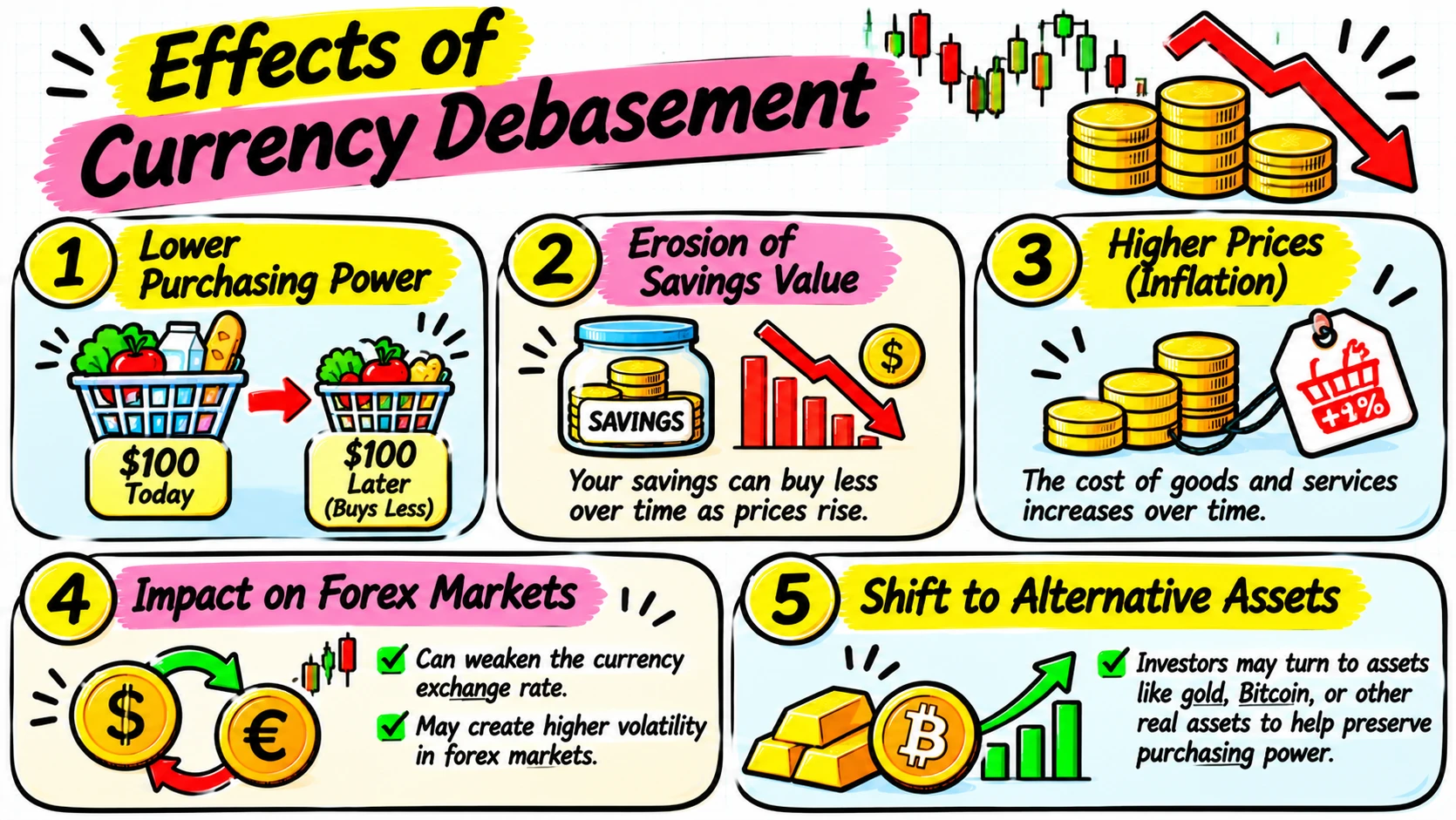 Currency debasement or persistent purchasing-power erosion can affect households, businesses, and financial markets.
1. Reduced Purchasing Power
One of the most direct effects is that money buys fewer goods and services over time.
Consumers may need more money to purchase food, transportation, housing, and other necessities.
2. Lower Real Value of Cash Savings
When inflation exceeds the interest earned on savings, the real purchasing power of those savings declines.
For example, suppose a savings account earns 2% annually while inflation is 5%.
Although the account balance increases, its purchasing power falls by approximately 2.86% over the year.
This illustrates why nominal returns and inflation-adjusted returns are different.
3. Pressure on Wages
If wages increase more slowly than consumer prices, workers experience declining real incomes.
Even when salaries remain unchanged, the amount of goods and services those salaries can purchase decreases.
4. Changes in Borrowing and Debt
Unexpected inflation can reduce the real value of fixed-rate debt.
However, lenders may respond to expected inflation by demanding higher interest rates.
Borrowers can also face difficulties if their income does not keep pace with inflation.
5. Financial Market Volatility
Concerns about monetary stability can influence bond yields, exchange rates, stock valuations, and commodity prices.
The effects vary depending on market expectations, central bank responses, and economic conditions.
How Currency Debasement Affects Forex Trading
Currency debasement is particularly relevant to the foreign exchange market.
Forex traders monitor the relative strength of different currencies, including changes in monetary policy, inflation, and investor confidence.
1. Inflation and Interest Rate Expectations
Central banks often respond to inflationary pressures by adjusting interest rates.
Higher interest rates may support a currency by increasing the potential returns available on assets denominated in that currency.
However, currency markets also consider expected future interest rates, economic growth, and financial risks.
2. Currency Depreciation
A currency may weaken against others when investors become concerned about inflation or monetary instability.
For example, if investors expect the US dollar to weaken relative to the euro, EUR/USD may rise.
However, this outcome is not guaranteed, because both currencies are affected by their respective economic conditions.
3. Market Sentiment
Investor sentiment can influence how markets respond to inflation reports and monetary policy announcements.
Traders may combine macroeconomic analysis with technical indicators and positioning data.
You can explore retail market positioning through the TraderSentiments Forex Sentiment Dashboard.
The Currency Strength Meter can also help traders compare relative currency movements.
These tools provide additional context, but they cannot predict exchange rates with certainty.
Currency Debasement and Gold
Gold is frequently discussed as a potential store of value during periods of monetary uncertainty.
Unlike fiat currency, physical gold cannot be created through central bank monetary policy.
Its supply is influenced by mining production, recycling, and existing above-ground holdings.
For this reason, some investors use gold as part of a strategy to diversify exposure to fiat currencies.
However, gold prices can be highly volatile.
Gold does not always rise when inflation increases, and its performance can be influenced by real interest rates, the US dollar, investor demand, and geopolitical developments.
Therefore, gold should not be viewed as guaranteed protection against currency debasement.
Currency Debasement and Bitcoin
Bitcoin is another asset frequently mentioned in discussions about currency debasement.
Its monetary design includes a maximum supply of approximately 21 million bitcoins.
Supporters argue that this predetermined supply makes Bitcoin different from fiat currencies whose monetary supply can expand.
However, limited supply does not guarantee price appreciation.
Bitcoin remains a volatile asset, and its market price depends on demand, liquidity, regulation, investor sentiment, and other factors.
While some investors view Bitcoin as a potential hedge against monetary instability, its effectiveness as a consistent inflation hedge remains uncertain.
How to Protect Against Currency Debasement
There is no single investment that provides guaranteed protection against inflation or declining currency purchasing power.
However, several financial practices may help individuals manage these risks.
1. Monitor Inflation
Follow inflation indicators such as the Consumer Price Index (CPI) and Personal Consumption Expenditures (PCE) price index.
These measures help assess changes in consumer prices.
2. Consider Inflation-Adjusted Returns
When evaluating investments or savings accounts, consider returns after inflation rather than focusing only on nominal gains.
3. Diversify Investments
Diversification across different asset classes may help reduce dependence on any single investment or currency.
However, diversification does not eliminate market risk.
4. Evaluate Inflation-Protected Securities
Certain government securities, such as US Treasury Inflation-Protected Securities (TIPS), are designed to adjust their principal value based on inflation.
Their market prices can still fluctuate, particularly when real interest rates change.
5. Follow Monetary Policy
Central bank interest rate decisions, monetary statements, and economic forecasts can provide useful information about inflation expectations and currency conditions.
Traders can use the educational resources at TraderSentiments to improve their understanding of financial markets.
Is Currency Debasement Always Bad?
Not every increase in the money supply or decline in purchasing power indicates an economic crisis.
Modern central banks generally aim for low and stable inflation rather than permanent price stability.
Moderate, predictable inflation can be consistent with a functioning economy.
Problems become more severe when inflation is unexpectedly high, persistent, or difficult to control.
Rapid monetary expansion can create risks, but the relationship between money supply, inflation, and economic growth is complex.
The most important factors are monetary credibility, economic stability, and whether inflation remains manageable.
Frequently Asked Questions
What is currency debasement in simple terms?
Currency debasement means reducing the underlying value of money. Historically, it involved lowering the precious metal content of coins. Today, the term is often used to describe declining purchasing power.
What is an example of currency debasement?
A historical example is reducing the silver content of a coin while keeping its face value unchanged. A modern example often described as debasement is persistent inflation that reduces the purchasing power of money.
Is currency debasement the same as inflation?
No. Inflation refers to a sustained rise in the general price level. Currency debasement historically refers to reducing a coin's precious metal content, although the term is also used more broadly in modern monetary discussions.
Does printing money cause currency debasement?
Rapid money creation can contribute to inflation if money growth exceeds the economy's capacity and demand for money. However, money creation does not automatically produce inflation.
Does currency debasement make gold more valuable?
Concerns about currency purchasing power can increase investor interest in gold, but gold prices are influenced by many other factors and are not guaranteed to rise.
Can Bitcoin protect against currency debasement?
Bitcoin has a limited maximum supply, which some investors consider attractive. However, its price is volatile, and it has not been established as a consistently reliable hedge against inflation.
How does currency debasement affect the US dollar?
Persistent inflation reduces the dollar's domestic purchasing power. However, the dollar's exchange rate against other currencies depends on relative economic conditions, interest rates, and investor demand.
How can traders monitor currency debasement?
Traders can follow inflation reports, money supply data, central bank policies, government fiscal conditions, exchange rates, and broader financial market sentiment.
Conclusion
Currency debasement refers to a reduction in the underlying value of money.
Historically, governments debased currencies by reducing the gold or silver content of coins.
Today, the term is often used to describe the erosion of purchasing power associated with inflation and monetary developments.
Understanding currency debasement can help investors and forex traders evaluate economic conditions, monetary policy, and potential risks to currency value.
However, it is important to distinguish between debasement, inflation, depreciation, and devaluation.
Each concept describes a different aspect of monetary value.
For more forex education, currency analysis, and market insights, explore TraderSentiments.com.
Disclaimer: This article is for educational purposes only and does not constitute financial or investment advice. Financial markets involve risk, and past performance does not guarantee future results.
Write Your Comment