

What Is a Trading System? How It Works, Types, and Examples
Successful trading is not just about finding the perfect entry point. It is about making consistent decisions, managing risk, and following a structured approach.
Many beginners enter the forex or stock market based on emotions, social media recommendations, or random trading signals. Without a clear plan, it becomes difficult to evaluate performance or maintain consistency.
This is where a trading system becomes important.
A trading system provides a set of rules that guide traders on when to enter a trade, when to exit, how much to risk, and how to manage open positions.
But what exactly is a trading system, how does it work, and how can you build one?
Let's explore the fundamentals, different types of trading systems, and practical examples.
What Is a Trading System?
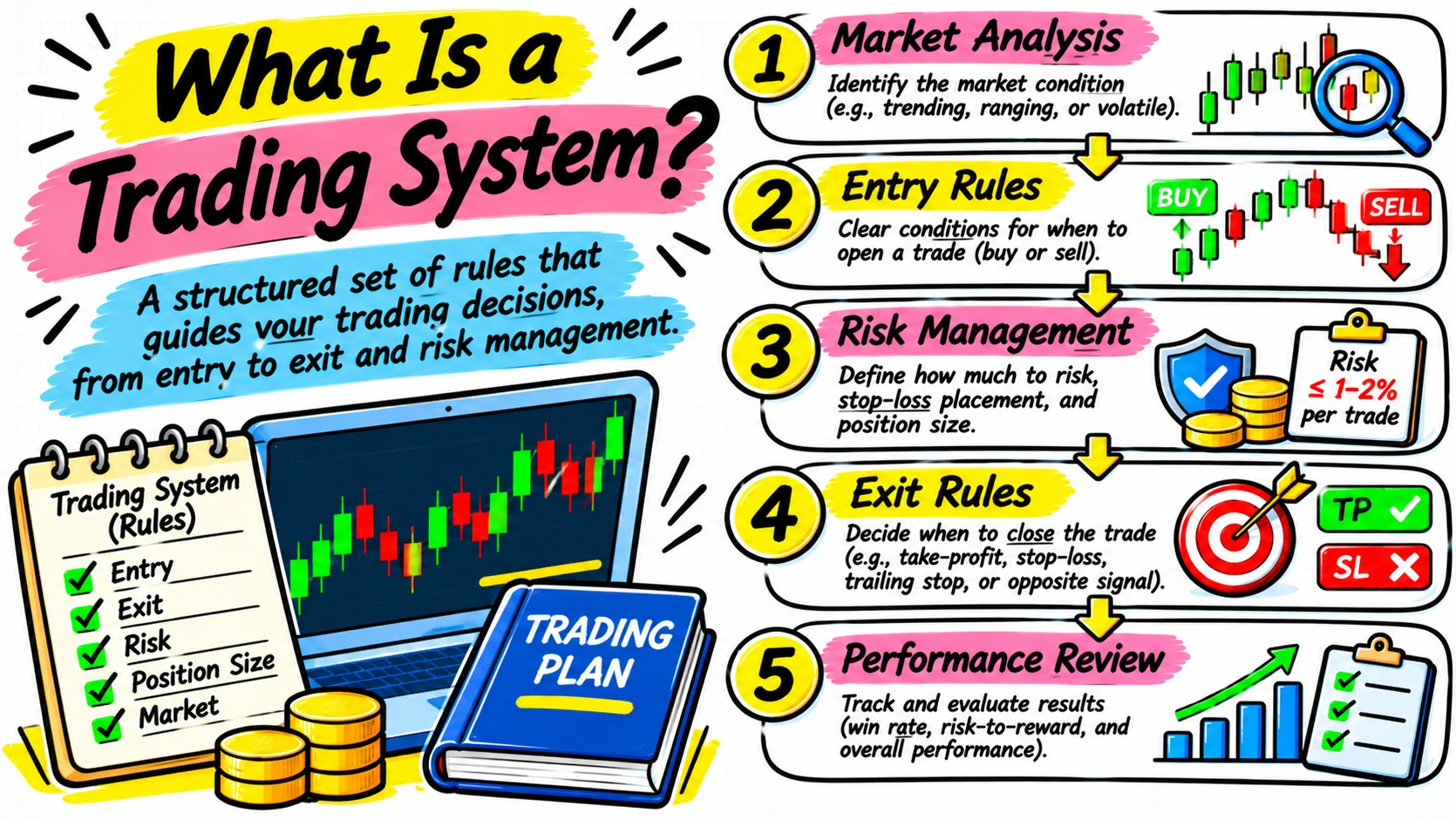
A trading system is a structured set of rules used to identify trading opportunities, execute trades, manage risk, and determine when to exit positions.
These rules can be followed manually by a trader or executed automatically using trading software.
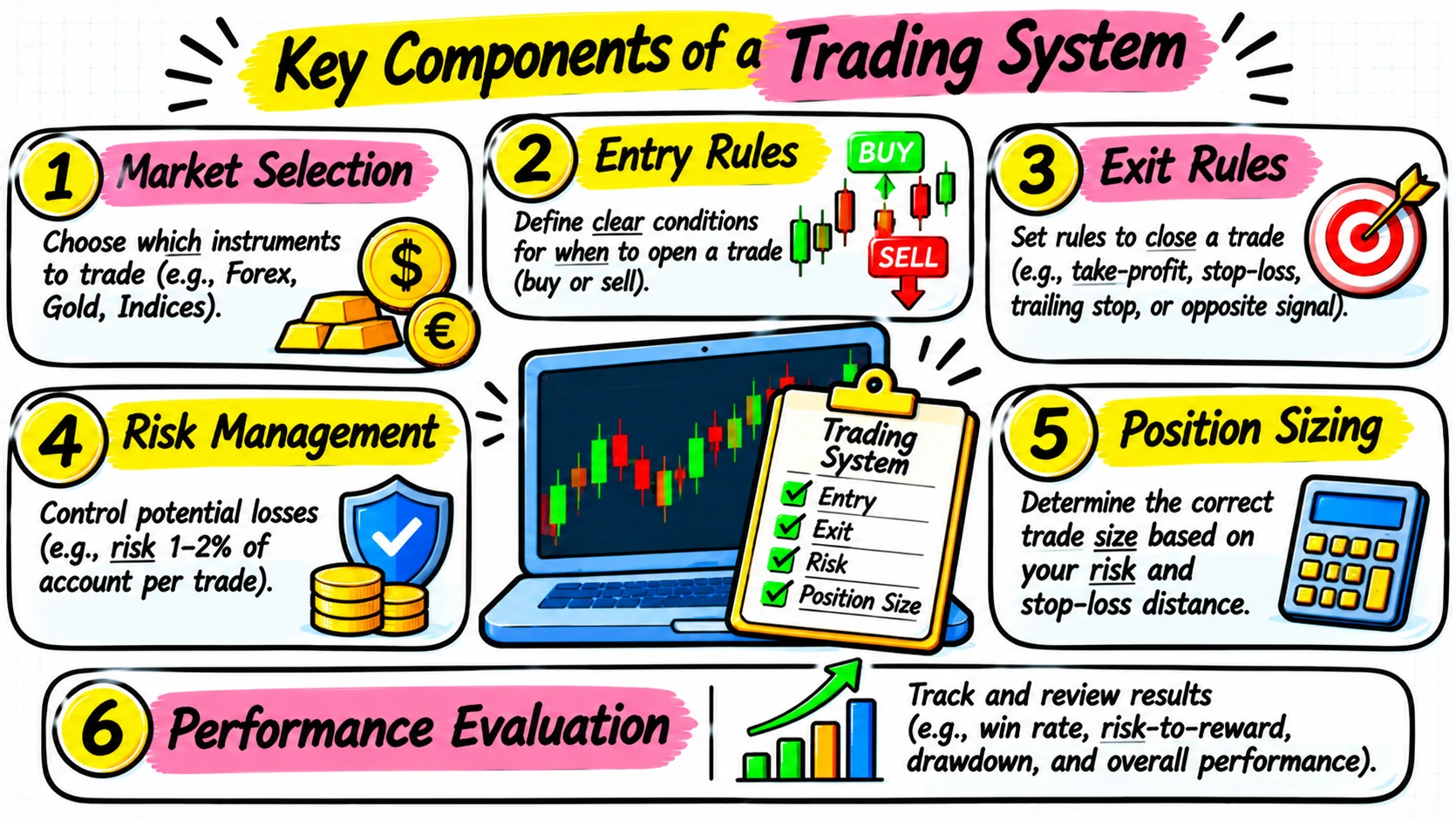
A complete trading system typically includes:
-
Market selection: Which financial instruments to trade.
-
Trading conditions: When the system is allowed to trade.
-
Entry rules: Specific conditions required to open a position.
-
Exit rules: When to close a winning or losing trade.
-
Risk management: How much capital to risk on each trade.
-
Position sizing: How to calculate the appropriate trade size.
-
Performance evaluation: How to measure and improve the system.
For example, a forex trading system might instruct a trader to buy EUR/USD when the market is trending upward, price breaks above a previous resistance level, and a confirmation candle closes above that level.
The system would also define the stop-loss, profit target, and maximum risk per trade.
The main objective is to make trading decisions more consistent and measurable.
How Does a Trading System Work?
 A trading system works by establishing predefined conditions that must be satisfied before a trade can be opened.
Instead of relying entirely on emotions or intuition, traders follow a repeatable decision-making process.
1. Identify Market Conditions
The first step is determining whether the market is trending, ranging, or experiencing high volatility.
Different trading systems perform differently under different market conditions.
For example, a trend-following system may work better during sustained directional movements, while a range-trading system may struggle during strong breakouts.
2. Generate Trading Signals
Once market conditions are identified, the system looks for potential entry opportunities.
Signals may be based on:
-
Moving averages.
-
Support and resistance.
-
Breakouts.
-
Candlestick patterns.
-
Technical indicators.
-
Price action.
-
Market structure.
-
Fundamental economic data.
A trading signal should have clear conditions that can be tested and repeated.
3. Determine Position Size
Before opening a position, the system calculates how much capital should be exposed to risk.
For example, a trader with a $10,000 account who risks 1% per trade would have a planned loss limit of $100.
Position size is then calculated based on the distance between the entry price and stop-loss.
4. Execute the Trade
When all entry conditions are satisfied, the trader opens the position.
In a manual system, the trader places the order.
In an automated system, trading software may execute the order according to programmed rules.
5. Manage and Exit the Position
The system defines when to exit the trade.
Possible exit conditions include:
-
Stop-loss triggered.
-
Take-profit reached.
-
Trailing stop activated.
-
Opposite trading signal.
-
Market conditions no longer support the setup.
-
A predefined time-based exit.
6. Review Trading Performance
After completing trades, the trader evaluates the results.
Important metrics include win rate, average profit, average loss, maximum drawdown, and trading expectancy.
These measurements help determine whether the system has demonstrated a statistical advantage.
Types of Trading Systems
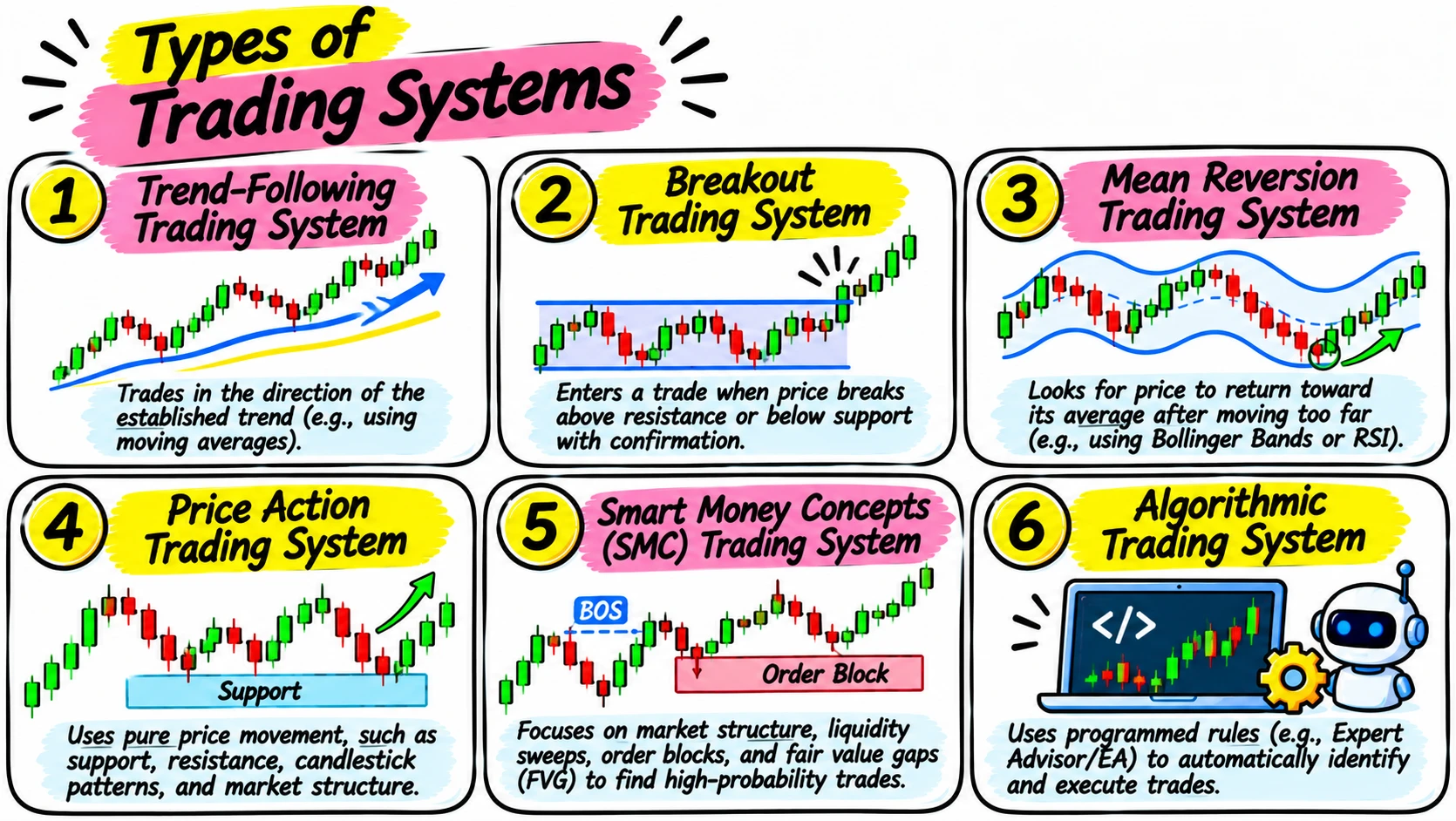 There are several types of trading systems, each designed for different market conditions and trading styles.
1. Trend-Following Trading System
A trend-following system attempts to identify and trade in the direction of an established market trend.
For example, traders may use moving averages to determine whether a currency pair is moving upward or downward.
A simple trend-following system might use these rules:
-
Buy when the 50-period moving average crosses above the 200-period moving average.
-
Sell or exit when the opposite crossover occurs.
-
Use a stop-loss based on market volatility.
Trend-following systems can capture extended price movements, but they may produce repeated losing signals in sideways markets.
2. Breakout Trading System
A breakout trading system looks for price movements beyond established support or resistance levels.
For example, if EUR/USD repeatedly fails to break above a resistance level, traders may monitor the market for a confirmed breakout.
A breakout system might require:
-
A clearly identified resistance level.
-
A candle closing above resistance.
-
A minimum breakout distance.
-
Additional confirmation from volatility or market structure.
However, breakouts can fail when price quickly returns to its previous trading range.
3. Mean Reversion Trading System
A mean reversion system is based on the idea that prices may return toward an average or equilibrium level after moving unusually far away.
Traders may use indicators such as Bollinger Bands or the Relative Strength Index (RSI).
For example, a trader might look for buying opportunities when price becomes unusually oversold within a ranging market.
However, strongly trending markets can remain overbought or oversold for extended periods.
4. Price Action Trading System
A price action system uses market movements, candlestick behavior, and price structure to identify trading opportunities.
Common elements include:
-
Support and resistance.
-
Swing highs and swing lows.
-
Candlestick formations.
-
Trendlines.
-
Breakouts and retests.
Price action systems can be used without relying heavily on technical indicators.
However, their rules must be sufficiently clear to reduce subjective interpretation.
5. Smart Money Concepts Trading System
A Smart Money Concepts (SMC) trading system focuses on market structure, liquidity, and selected price zones.
Common concepts include:
-
Break of Structure (BOS).
-
Change of Character (CHoCH).
-
Liquidity sweeps.
-
Order blocks.
-
Fair Value Gaps (FVG).
For example, a trader might wait for price to sweep a previous low, show a bullish structure shift, and retrace into a predefined entry zone.
These patterns provide a framework for trade selection, but they do not guarantee profitable outcomes or prove institutional participation.
Learn more in the TraderSentiments Smart Money Concepts Guide.
6. Algorithmic Trading System
An algorithmic trading system uses computer programs to identify trading signals and execute orders.
These systems can operate according to predefined rules without requiring constant manual intervention.
In forex trading, automated systems are commonly known as Expert Advisors (EAs), particularly on MetaTrader platforms.
Algorithmic systems may offer consistent rule execution and faster order placement, but they can still suffer from coding errors, execution problems, and unexpected market conditions.
Manual vs. Automated Trading Systems
Trading systems can be operated manually or automatically.
| Feature | Manual Trading System | Automated Trading System |
|---|---|---|
| Trade execution | Trader places orders | Software places orders |
| Decision-making | Human follows predefined rules | Program follows coded rules |
| Monitoring | Usually requires more attention | Can operate with less direct supervision |
| Emotional influence | Higher potential | Reduced during execution |
| Execution speed | Depends on the trader | Often faster |
| Technical requirements | Lower | Requires programming or software |
| Main risks | Human error and inconsistency | Coding errors, overfitting, technical failures |
Neither approach is automatically more profitable.
The quality of the underlying strategy, risk management, and execution matters more than whether trades are placed manually or automatically.
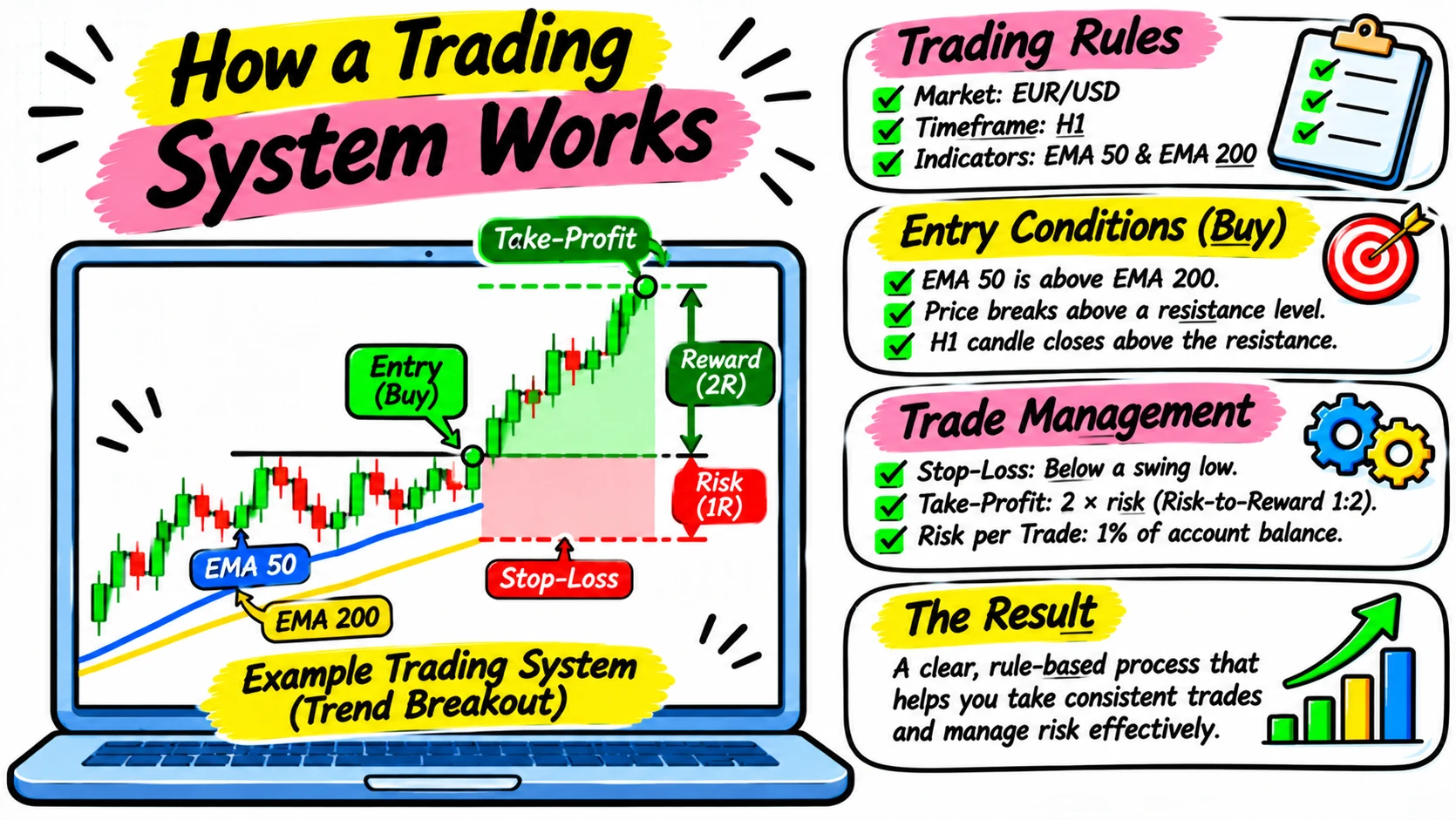
Example of a Simple Forex Trading System
Let's build a hypothetical trading system using moving averages and a breakout confirmation.
System name: Trend Breakout Trading System
Market: EUR/USD
Timeframe: 1-hour chart (H1)
Indicators: 50-period and 200-period exponential moving averages (EMA).
Entry Rules
A buy trade is permitted only when:
-
The 50 EMA is above the 200 EMA.
-
Price is trading above both moving averages.
-
Price breaks above a previously identified resistance level.
-
An H1 candle closes above that resistance.
-
The trade offers at least a 1:2 planned risk-to-reward ratio.
If any condition is missing, no trade is opened.
Stop-Loss Rules
Place the stop-loss below a relevant swing low or another objectively defined invalidation level.
The distance to the stop-loss determines the position size.
Take-Profit Rules
Set the initial profit target at twice the planned risk.
For example:
-
Trading account: $10,000.
-
Planned risk: 1% ($100).
-
Potential profit: $200.
-
Risk-to-reward ratio: 1:2.
Trade Management Rules
Avoid opening additional trades when the account's predefined maximum combined risk has been reached.
Close the trade when the stop-loss, take-profit, or another defined exit condition is triggered.
This is an educational example, not a validated profitable strategy.
The rules would need to be backtested and evaluated before being used with real money.
How to Build Your Own Trading System
Creating a trading system requires more than selecting a technical indicator.
A reliable development process should include the following steps.
Step 1: Choose Your Trading Market
Decide whether to trade forex, stocks, commodities, indices, or cryptocurrencies.
Different markets have different trading hours, liquidity, volatility, and transaction costs.
Step 2: Select a Trading Timeframe
Choose a timeframe that matches your trading style.
For example:
-
Scalping: M1–M5.
-
Intraday trading: M15–H1.
-
Swing trading: H4–D1.
-
Position trading: Daily and weekly charts.
These are common examples rather than fixed requirements.
Step 3: Define Entry Conditions
Your entry rules should be specific enough that another trader could identify the same signal.
Instead of saying "buy when the market looks bullish," define measurable conditions.
For example:
"Open a buy position when the 50 EMA is above the 200 EMA and an H1 candle closes above the previous 20-bar high."
Step 4: Establish Risk Management
Risk management determines how much capital may be lost when a trade fails.
Common considerations include:
-
Maximum risk per trade.
-
Maximum combined open risk.
-
Daily or weekly loss limits.
-
Position sizing.
-
Stop-loss placement.
-
Maximum account drawdown.
Some traders use 0.5% or 1% of account equity as a planned risk allocation per trade.
However, no percentage is appropriate for every trader or strategy.
Step 5: Define Exit Rules
Every trading system should specify how positions are closed.
Without clear exit rules, traders may hold losing positions too long or close winning trades prematurely.
Step 6: Backtest the System
Backtesting involves applying trading rules to historical market data.
The objective is to evaluate how the system would have performed under previous market conditions.
A useful backtest should account for:
-
Trading spreads.
-
Commissions.
-
Slippage assumptions.
-
Historical market conditions.
-
Sample size.
-
Drawdowns.
-
Out-of-sample performance.
Backtesting cannot guarantee future profitability.
Step 7: Forward Test on a Demo Account
After backtesting, traders can evaluate the system using live market data without risking real capital.
Forward testing can reveal execution issues and differences between historical simulations and real-time market behavior.
Step 8: Monitor and Improve
Trading systems should be reviewed periodically.
However, making frequent changes based on a handful of losing trades can lead to overfitting and inconsistent results.
Improvements should be supported by sufficient data and a clear testing process.
How to Know if a Trading System Is Profitable
A trading system should not be evaluated using win rate alone.
Several performance metrics provide a more complete picture.
1. Win Rate
Win rate measures the percentage of trades that close profitably.
Win Rate = (Winning Trades ÷ Total Trades) × 100
For example, if a system wins 45 out of 100 trades, its win rate is 45%.
A lower win rate does not necessarily mean a system is unprofitable.
2. Risk-to-Reward Ratio
Risk-to-reward ratio compares the planned potential loss with the planned potential profit.
For example, risking $100 to potentially earn $200 produces a 1:2 risk-to-reward ratio.
Actual realized profits and losses may differ from planned amounts.
3. Trading Expectancy
Trading expectancy measures the average expected result per trade.
Expectancy = (Win Rate × Average Win) − (Loss Rate × Average Loss)
For example:
-
Win rate: 45%.
-
Loss rate: 55%.
-
Average winning trade: $200.
-
Average losing trade: $100.
Expectancy:
(0.45 × $200) − (0.55 × $100)
= $90 − $55
= +$35 per trade
This represents positive historical expectancy before any trading costs not already included.
However, estimated expectancy can change as market conditions evolve.
4. Maximum Drawdown
Maximum drawdown measures the largest peak-to-trough decline in account equity over a specified period.
A system may generate positive returns while experiencing drawdowns that are unacceptable for some traders.
5. Profit Factor
Profit factor compares gross trading profits with gross trading losses.
Profit Factor = Gross Profit ÷ Gross Loss
A profit factor above 1 indicates that gross profits exceeded gross losses during the measured period.
However, a high profit factor based on very few trades may not be statistically meaningful.
How Market Sentiment Can Improve Trading System Analysis
Some traders incorporate market sentiment as an additional filter within their trading systems.
Market sentiment refers to the positioning or overall outlook of market participants.
For example, a trader may use retail positioning data to determine whether a currency pair has unusually one-sided positioning.
Extreme positioning can sometimes provide useful contrarian context, but it does not guarantee a reversal.
You can monitor long and short retail positioning through the TraderSentiments Forex Sentiment Dashboard.
Traders can also compare currency movements using the Currency Strength Meter.
These tools can help provide additional context when evaluating trading setups.
However, adding more indicators does not automatically improve a trading system.
Every additional filter should be tested to determine whether it provides measurable value.
Common Trading System Mistakes
1. Trading Without Clear Rules
Vague entry and exit conditions make it difficult to measure performance or maintain consistency.
2. Overcomplicating the Strategy
Using too many indicators can create conflicting signals and unnecessary complexity.
A simpler system with clearly defined rules may be easier to evaluate.
3. Ignoring Risk Management
Even a system with a relatively high win rate can experience substantial losses when position sizes are excessive.
4. Overfitting Historical Data
Overfitting occurs when a strategy is excessively optimized to past market conditions.
A system may appear highly profitable in backtesting but perform poorly on new data.
5. Changing Rules After Every Loss
All trading systems experience losing trades.
Frequent adjustments based on short-term outcomes can prevent meaningful performance evaluation.
6. Ignoring Trading Costs
Spreads, commissions, swaps, and slippage can significantly affect trading results.
This is especially important for high-frequency and scalping systems.
7. Expecting Guaranteed Profits
No trading system can guarantee profits.
Market conditions change, and even historically profitable strategies can experience extended periods of underperformance.
Trading System vs. Trading Strategy: What's the Difference?
The terms trading system and trading strategy are often used interchangeably, but there is a useful distinction.
A trading strategy describes the general approach used to identify trading opportunities.
For example, a trader may use a breakout strategy.
A trading system turns that strategy into a complete operational framework.
It defines the entry conditions, exit rules, position sizing, risk limits, and performance measurements.
For example:
Trading strategy: Buy bullish breakouts.
Trading system: Buy when an H1 candle closes above the previous 20-bar high, the 50 EMA is above the 200 EMA, the stop-loss is placed at a defined invalidation level, and planned risk is limited to 1% of equity.
In other words, a strategy explains the trading idea, while a system defines how the idea is consistently executed and evaluated.
Frequently Asked Questions
What is a trading system in simple terms?
A trading system is a set of predefined rules that tells a trader when to buy, when to sell, how much to risk, and how to manage a trade.
What is an example of a trading system?
A moving average crossover system is one example. It may generate buy signals when a shorter moving average crosses above a longer moving average and exit signals when the opposite crossover occurs.
What are the main components of a trading system?
The main components include market selection, entry rules, exit rules, risk management, position sizing, trade execution, and performance evaluation.
What is the difference between a trading system and a trading strategy?
A trading strategy describes the general method used to find opportunities. A trading system provides the detailed rules for implementing and managing that strategy.
Can a trading system be automated?
Yes. A trading system can be programmed into software such as an Expert Advisor (EA) for MetaTrader, provided its rules can be expressed clearly enough for automation.
Is a trading system profitable?
Some trading systems can demonstrate positive expectancy, but profitability is not guaranteed. Results depend on the strategy, market conditions, execution, trading costs, and risk management.
What is the best trading system for beginners?
Beginners may benefit from starting with a simple, rule-based system that includes clear entry conditions, predefined stop-losses, conservative position sizing, and a process for evaluating performance.
Do professional traders use trading systems?
Many professional traders and institutions use structured trading processes, including systematic, discretionary, and algorithmic approaches.
How long should I backtest a trading system?
There is no universally correct duration. A useful backtest should include sufficient trades and different market conditions, with separate data reserved for out-of-sample evaluation.
Conclusion
A trading system is a structured framework that helps traders make consistent decisions about entries, exits, position sizing, and risk management.
Whether manual or automated, a trading system should be based on clearly defined rules that can be tested and evaluated.
Popular approaches include trend-following, breakout trading, mean reversion, price action, Smart Money Concepts, and algorithmic trading.
However, no trading system guarantees profits.
Long-term performance depends on the quality of the underlying strategy, disciplined execution, realistic risk management, and continuous evaluation.
For traders looking to incorporate additional market context into their analysis, explore the TraderSentiments Forex Sentiment Dashboard and Currency Strength Meter.
Visit TraderSentiments.com for more trading education and market analysis tools.
Disclaimer: This article is for educational and informational purposes only and does not constitute financial or investment advice. Trading forex, stocks, commodities, and cryptocurrencies involves financial risk. Past performance does not guarantee future results.
Write Your Comment