

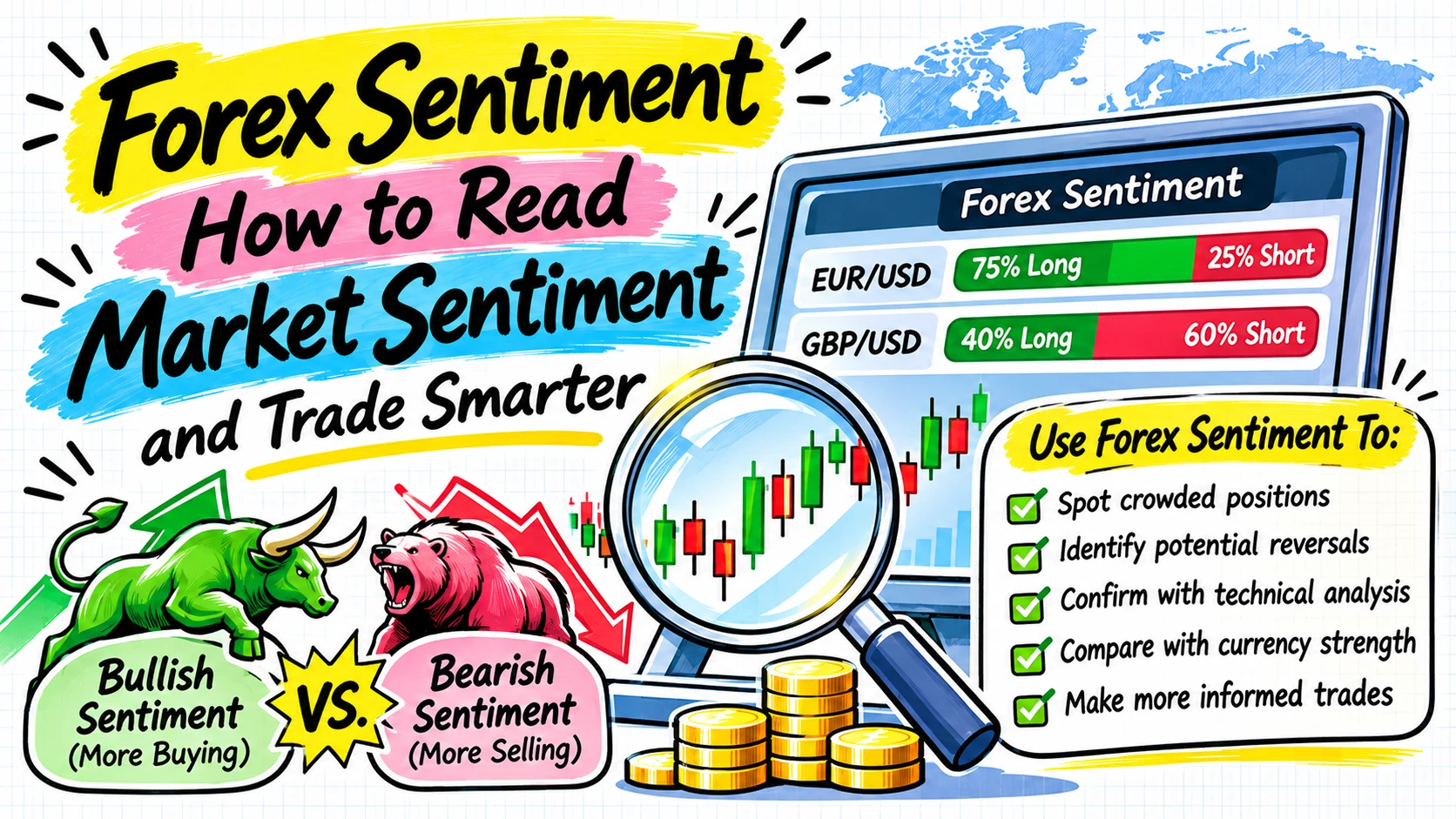
Forex sentiment is an important tool for understanding how traders are positioned in the foreign exchange market. While technical analysis focuses on price movements and fundamental analysis examines economic conditions, forex sentiment analysis reveals whether traders are predominantly buying or selling a currency pair.
Understanding market sentiment can help traders identify crowded positions, evaluate potential reversals, and improve their trading decisions.
In this guide, we'll explain what forex sentiment means, how bullish and bearish sentiment work, and how to use a forex sentiment indicator in your trading strategy.
You can also monitor current market positioning using the free Live Forex Sentiment Dashboard from TraderSentiments.
What Is Forex Sentiment?

Forex sentiment refers to the overall attitude or positioning of traders toward a particular currency pair.
It helps answer a simple question: Are most traders buying or selling?
Forex sentiment is commonly measured using the percentage of traders holding long (buy) and short (sell) positions.
For example, consider the following hypothetical EUR/USD positioning:
-
75% of traders hold long positions.
-
25% of traders hold short positions.
This indicates that the majority of traders in the measured sample expect EUR/USD to rise.
However, a large percentage of long positions does not necessarily mean the price will continue rising.
In fact, some traders interpret extreme retail positioning as a potential warning that the market has become overcrowded.
This approach is known as contrarian sentiment analysis.
How Does Forex Sentiment Work?
Forex sentiment indicators collect positioning data from brokers or other market participants to estimate how traders are positioned.
The two main measurements are:
Long Position Percentage
The percentage of traders holding buy positions in a particular currency pair.
Short Position Percentage
The percentage of traders holding sell positions in a particular currency pair.
For example:
-
EUR/USD: 70% long, 30% short.
-
GBP/USD: 40% long, 60% short.
-
USD/JPY: 50% long, 50% short.
These figures are hypothetical examples, not live market readings.
A higher long percentage indicates that more traders in the sample are buying, while a higher short percentage indicates that more are selling.
Because the forex market is decentralized, sentiment indicators generally reflect the traders covered by their data sources rather than the entire global market.
For a broader perspective, visit the TraderSentiments Market Sentiment Dashboard, which provides access to sentiment information across multiple asset classes.
Bullish vs. Bearish Forex Sentiment
Understanding the difference between bullish and bearish sentiment is essential.
Bullish Forex Sentiment
Bullish sentiment means traders generally expect a currency pair to increase in value.
For example, when most retail traders hold buy positions in GBP/USD, retail positioning is considered bullish.
This may reflect optimism about the British pound or expectations that the US dollar will weaken.
However, bullish retail positioning does not guarantee rising prices.
Bearish Forex Sentiment
Bearish sentiment means traders generally expect a currency pair to decline.
For example, if 80% of retail traders are short EUR/USD, retail positioning is strongly bearish.
A contrarian trader might interpret this as a potential bullish opportunity, particularly if price begins showing signs of upward reversal.
Neutral Forex Sentiment
Neutral sentiment occurs when buying and selling positions are relatively balanced.
A 50% long and 50% short reading suggests that neither side dominates the measured retail positioning.
Neutral positioning does not necessarily mean low volatility or a sideways market.
What Is Contrarian Forex Sentiment?
Contrarian sentiment analysis is a trading approach that examines whether the majority of traders may be positioned on the wrong side of a market move.
Instead of automatically following the crowd, contrarian traders look for unusually crowded positions.
For example:
-
If 80% of retail traders are buying EUR/USD, a contrarian trader may investigate bearish opportunities.
-
If 80% of retail traders are selling GBP/USD, a contrarian trader may investigate bullish opportunities.
The reasoning is that extreme positioning can leave a market vulnerable to sharp moves when traders close losing positions or when new information changes expectations.
However, extreme sentiment can persist for extended periods. A heavily long market can continue rising, and a heavily short market can continue falling.
Contrarian sentiment should therefore be treated as a warning or confirmation tool, not an automatic buy or sell signal.
How to Read a Forex Sentiment Indicator
A forex sentiment indicator typically displays long and short percentages for individual currency pairs.
Consider this hypothetical example:
EUR/USD Sentiment
-
Long positions: 78%
-
Short positions: 22%
-
Retail positioning: Strongly long
-
Possible contrarian interpretation: Bearish
The majority of sampled retail traders are buying EUR/USD.
A contrarian trader may become cautious about opening additional buy positions, especially if EUR/USD approaches a significant resistance level.
Before considering a sell trade, the trader could wait for additional confirmation, such as a bearish candlestick pattern, a market structure break, or weakening upward momentum.
You can compare live positioning across major currency pairs using the Forex Sentiment Indicator.
How to Use Forex Sentiment in Trading
 Forex sentiment becomes more useful when combined with technical analysis, currency strength, and economic developments.
1. Identify Extreme Retail Positioning
Look for currency pairs with unusually high long or short percentages.
For example, a reading of 85% long and 15% short may indicate a heavily crowded long position among the traders covered by the indicator.
This can help identify markets worth investigating for possible reversals.
There is no universal sentiment threshold that guarantees a reversal.
2. Confirm With Support and Resistance
Sentiment becomes more meaningful when price approaches an important technical level.
Imagine EUR/USD is approaching a major resistance zone while 82% of retail traders are long.
If price fails to break resistance and forms a bearish reversal pattern, the combination may support a bearish trading hypothesis.
Without price confirmation, selling simply because retail traders are heavily long can be risky.
3. Compare Currency Strength
Currency strength analysis helps determine which currencies are gaining or losing momentum relative to others.
For example, if the US dollar is strengthening across several major pairs while retail traders remain heavily long EUR/USD, the two observations may reinforce a bearish EUR/USD scenario.
You can compare major currencies using the free Currency Strength Meter.
Combining positioning data with currency strength provides additional context, although neither indicator guarantees future performance.
4. Monitor Economic News
Major economic events can rapidly change market expectations and positioning.
Important announcements include:
-
Central bank interest rate decisions.
-
US Non-Farm Payrolls (NFP).
-
Consumer Price Index (CPI) inflation reports.
-
Gross Domestic Product (GDP) releases.
-
Central bank speeches and monetary policy statements.
For example, even if retail traders are heavily short USD/JPY, an unexpected central bank announcement could cause further selling rather than a reversal.
Monitor relevant developments through Forex News and Sentiment Analysis.
5. Apply Risk Management
Sentiment indicators cannot predict market direction with certainty.
Before entering a trade, define your entry conditions, stop-loss level, position size, and potential reward relative to risk.
Avoid increasing your position size solely because sentiment has reached an extreme.
Forex Sentiment Trading Strategy: Practical Example
Consider a hypothetical EUR/USD trading setup.
Step 1: Check Sentiment
The sentiment indicator shows 80% long positions and 20% short positions.
This suggests heavily crowded retail buying.
Step 2: Analyze Price Structure
EUR/USD is approaching a previously tested resistance zone.
Price attempts to break higher but repeatedly fails to sustain the move.
Step 3: Check Currency Strength
The US dollar begins strengthening against several major currencies.
This may support a bearish EUR/USD outlook.
Step 4: Wait for Confirmation
A bearish market structure break occurs below a recent swing low.
The trader now has multiple observations supporting the same trading hypothesis.
Step 5: Plan the Trade
A potential short entry may be considered after confirmation, with a stop-loss placed according to the trader's strategy and an appropriate position size.
This is an educational example, not a live trading recommendation.
What Is the Best Forex Sentiment Indicator?
The best forex sentiment indicator depends on the type of information a trader needs.
Some indicators focus on retail long-versus-short positioning, while others analyze institutional futures positioning, options markets, or news sentiment.
Retail sentiment tools are particularly useful for identifying crowded trades.
Institutional positioning reports can provide longer-term context, while news sentiment analysis helps explain changing market expectations.
TraderSentiments offers a free Live Forex Sentiment Dashboard that displays aggregated retail positioning across major forex pairs, including long and short percentages and contrarian bias labels.
Traders can use these readings alongside price action and other market analysis tools.
Common Forex Sentiment Trading Mistakes
1. Trading Against the Crowd Too Early
Extreme retail positioning does not mean a reversal will happen immediately.
2. Ignoring the Market Trend
A strong trend can continue despite heavily one-sided sentiment.
3. Treating Sentiment as a Guaranteed Signal
Sentiment is one analytical input, not a complete trading strategy.
4. Ignoring Economic Events
Unexpected news can overwhelm technical setups and positioning signals.
5. Assuming Retail Sentiment Represents the Entire Market
Broker positioning data covers specific groups of traders and may differ across providers.
Avoiding these mistakes can help traders use sentiment more responsibly.
Frequently Asked Questions About Forex Sentiment
What is forex sentiment?
Forex sentiment describes the overall positioning or expectations of traders toward a currency pair. It is commonly measured through the percentage of long and short positions.
Is forex sentiment a leading indicator?
Forex sentiment can highlight positioning extremes and potential market vulnerabilities, but it does not reliably predict the timing or direction of future price movements.
What does 80% long mean in forex sentiment?
It means 80% of the measured traders or accounts are holding long positions, according to the indicator's methodology. Contrarian traders may interpret this as crowded buying, but it does not guarantee a bearish move.
Is bullish sentiment good for a currency?
Bullish sentiment indicates optimism or buying interest among the measured participants. Whether the currency rises depends on many additional factors, including economic conditions, institutional activity, and market liquidity.
Can forex sentiment predict reversals?
Extreme sentiment can help identify conditions in which reversals are worth monitoring. However, it cannot consistently predict when a reversal will occur.
How often should I check forex sentiment?
Day traders may check sentiment several times during their trading sessions, while swing traders may review positioning less frequently. The appropriate frequency depends on the strategy and how often the underlying data updates.
Where can I check forex sentiment for free?
You can access long and short positioning data for major currency pairs using the free TraderSentiments Forex Sentiment Dashboard.
Conclusion
Forex sentiment analysis provides valuable insight into how retail traders are positioned across currency pairs.
By monitoring long and short ratios, traders can identify crowded positions, evaluate contrarian opportunities, and better understand market behavior.
However, sentiment is most effective when combined with technical analysis, currency strength, fundamental developments, and disciplined risk management.
Want to see how traders are positioned right now?
Explore the Live Forex Sentiment Dashboard at TraderSentiments.com and compare market positioning before planning your next trade.
Disclaimer: This article is for educational and informational purposes only and does not constitute financial or investment advice. Forex trading involves substantial risk, including the potential loss of invested capital.
Write Your Comment