

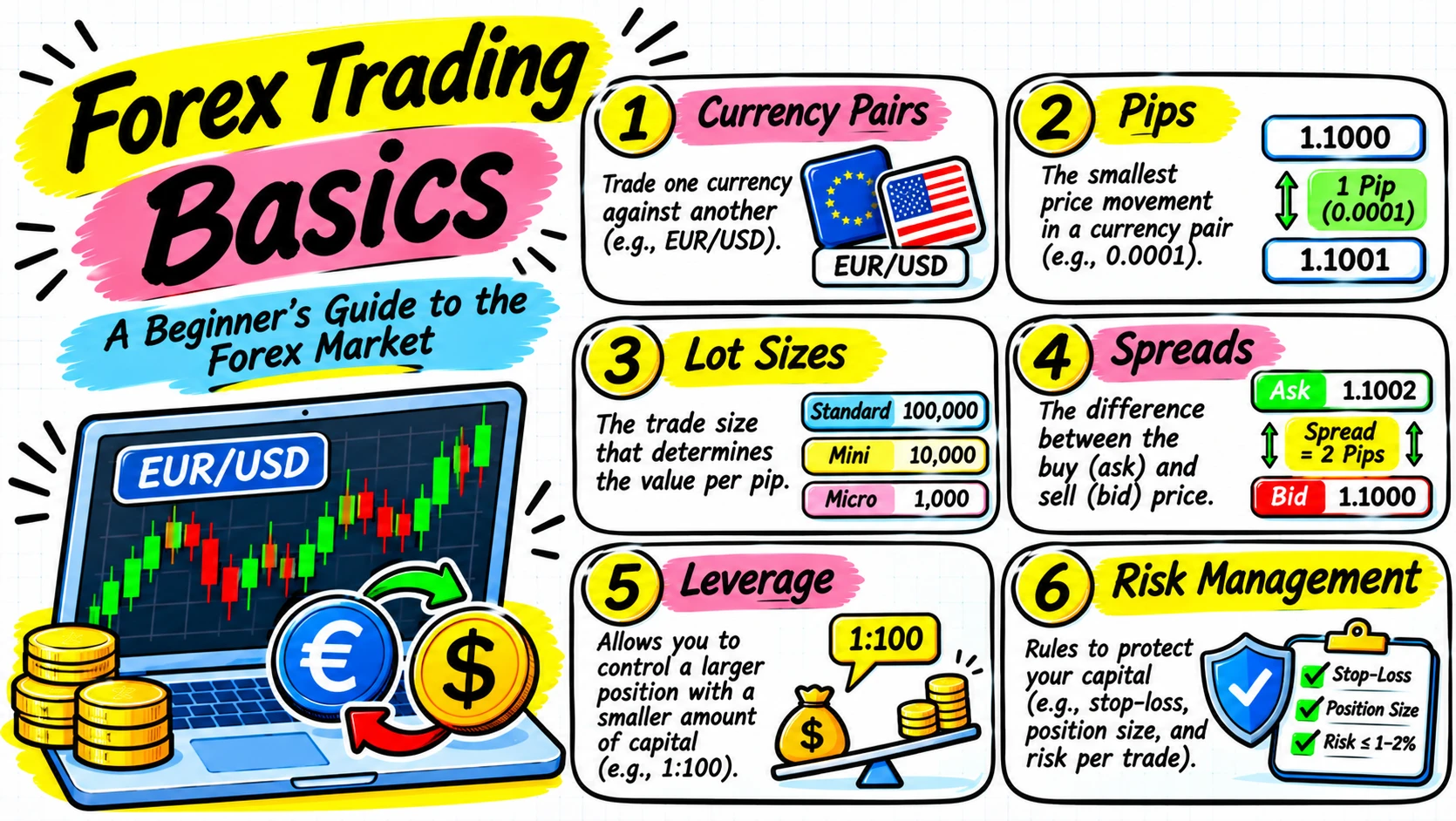
Forex Trading Basics: A Complete Beginner's Guide to Forex Trading
Forex trading is one of the most popular ways to participate in global financial markets. Every day, currencies are bought and sold by banks, businesses, investors, and individual traders.
But if you're new to trading, terms such as pips, lots, leverage, spreads, and currency pairs can seem confusing.
Understanding the forex trading basics is the first step toward learning how the foreign exchange market works and how traders manage potential opportunities and risks.
In this beginner's guide, we'll explain what forex trading is, how currency pairs work, essential trading terminology, common trading strategies, and the importance of risk management.
What Is Forex Trading?
Forex trading, also known as foreign exchange trading or FX trading, is the buying and selling of currencies to profit from changes in exchange rates.
The forex market is a global, decentralized financial market where participants exchange one currency for another.
For example, a trader might buy the euro against the US dollar if they expect the euro to strengthen relative to the dollar.
If the exchange rate moves in the expected direction, the trader may earn a profit.
However, if the exchange rate moves against the position, the trader may experience a loss.
Forex trading involves two currencies at the same time because currencies are traded in pairs.
How Does Forex Trading Work?
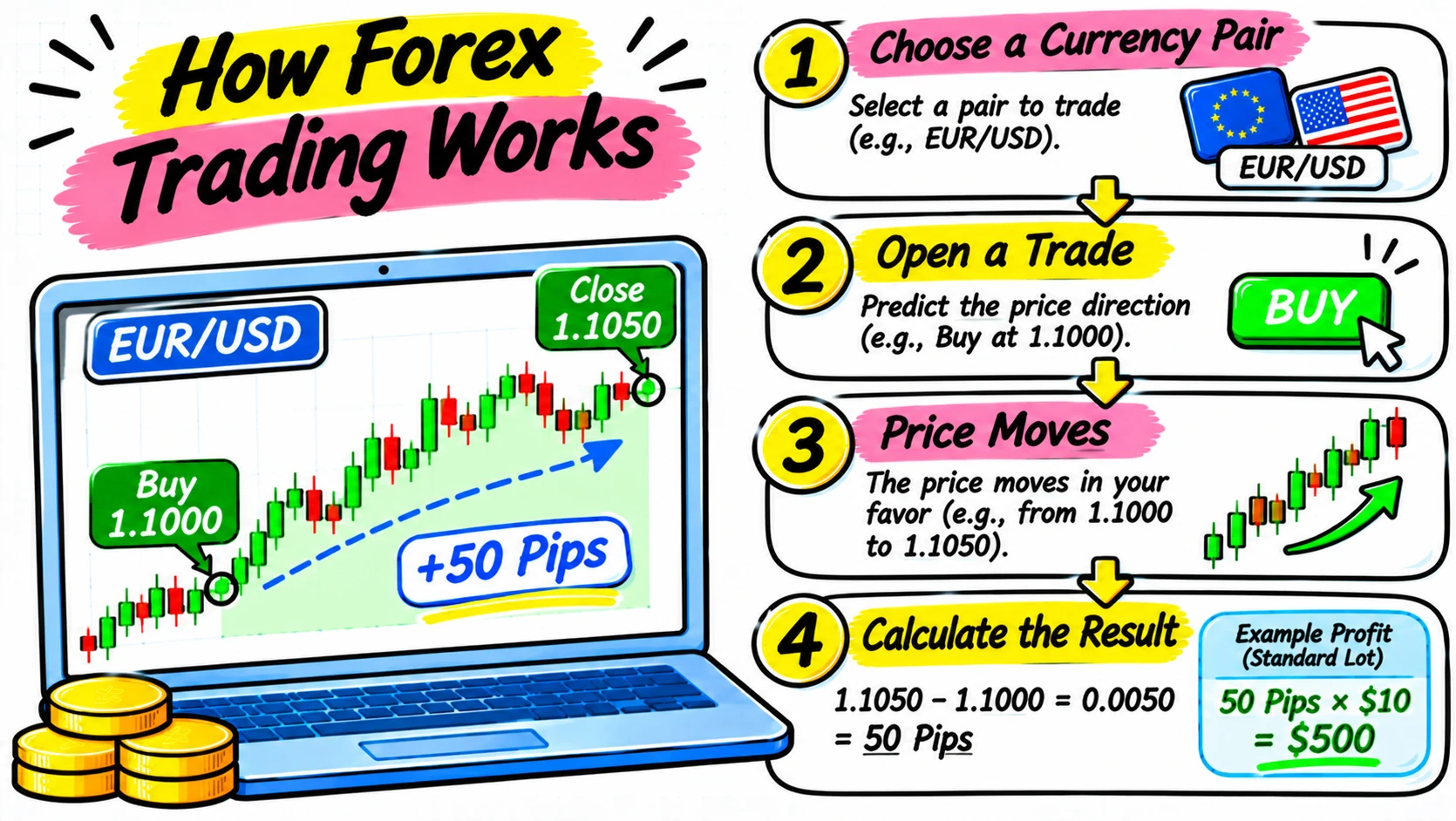
Forex trading involves speculating on the relative value of one currency compared with another.
For example, consider the currency pair EUR/USD.
If EUR/USD is trading at 1.1000, it means:
1 euro = 1.1000 US dollars.
A trader who expects the euro to strengthen against the US dollar may open a buy position.
A trader who expects the euro to weaken may open a sell position.
Example of a Forex Buy Trade
Suppose EUR/USD is trading at 1.1000.
You buy EUR/USD because you expect the exchange rate to rise.
Later, the price increases to 1.1050.
The difference is 0.0050, or 50 pips.
If you traded one standard lot, this movement would represent approximately $500 in gross profit, excluding trading costs.
However, if the price moved 50 pips against your position, the gross loss would be approximately $500.
This demonstrates how forex traders can profit or lose money from relatively small exchange-rate movements.
Understanding Currency Pairs
Currencies are traded in pairs because forex transactions involve exchanging one currency for another.
Each currency pair contains two components.
Base currency: The first currency in the pair.
Quote currency: The second currency in the pair.
For example:
EUR/USD
-
EUR = Base currency.
-
USD = Quote currency.
If EUR/USD is trading at 1.1000, one euro is worth 1.1000 US dollars.
Major Currency Pairs
Major currency pairs include the US dollar and another heavily traded currency.
Examples include:
-
EUR/USD — Euro / US Dollar.
-
GBP/USD — British Pound / US Dollar.
-
USD/JPY — US Dollar / Japanese Yen.
-
USD/CHF — US Dollar / Swiss Franc.
-
AUD/USD — Australian Dollar / US Dollar.
-
USD/CAD — US Dollar / Canadian Dollar.
-
NZD/USD — New Zealand Dollar / US Dollar.
Major currency pairs generally offer relatively high liquidity, although trading conditions vary by broker and market conditions.
Minor Currency Pairs
Minor currency pairs, also called cross-currency pairs, do not include the US dollar.
Examples include:
-
EUR/GBP.
-
EUR/JPY.
-
GBP/JPY.
-
AUD/NZD.
Exotic Currency Pairs
Exotic pairs typically combine a major currency with one from an emerging or less frequently traded market.
Examples include:
-
USD/TRY — US Dollar / Turkish Lira.
-
USD/ZAR — US Dollar / South African Rand.
-
USD/MXN — US Dollar / Mexican Peso.
Exotic pairs can have wider spreads and lower liquidity than major currency pairs.
Essential Forex Trading Terms Every Beginner Should Know
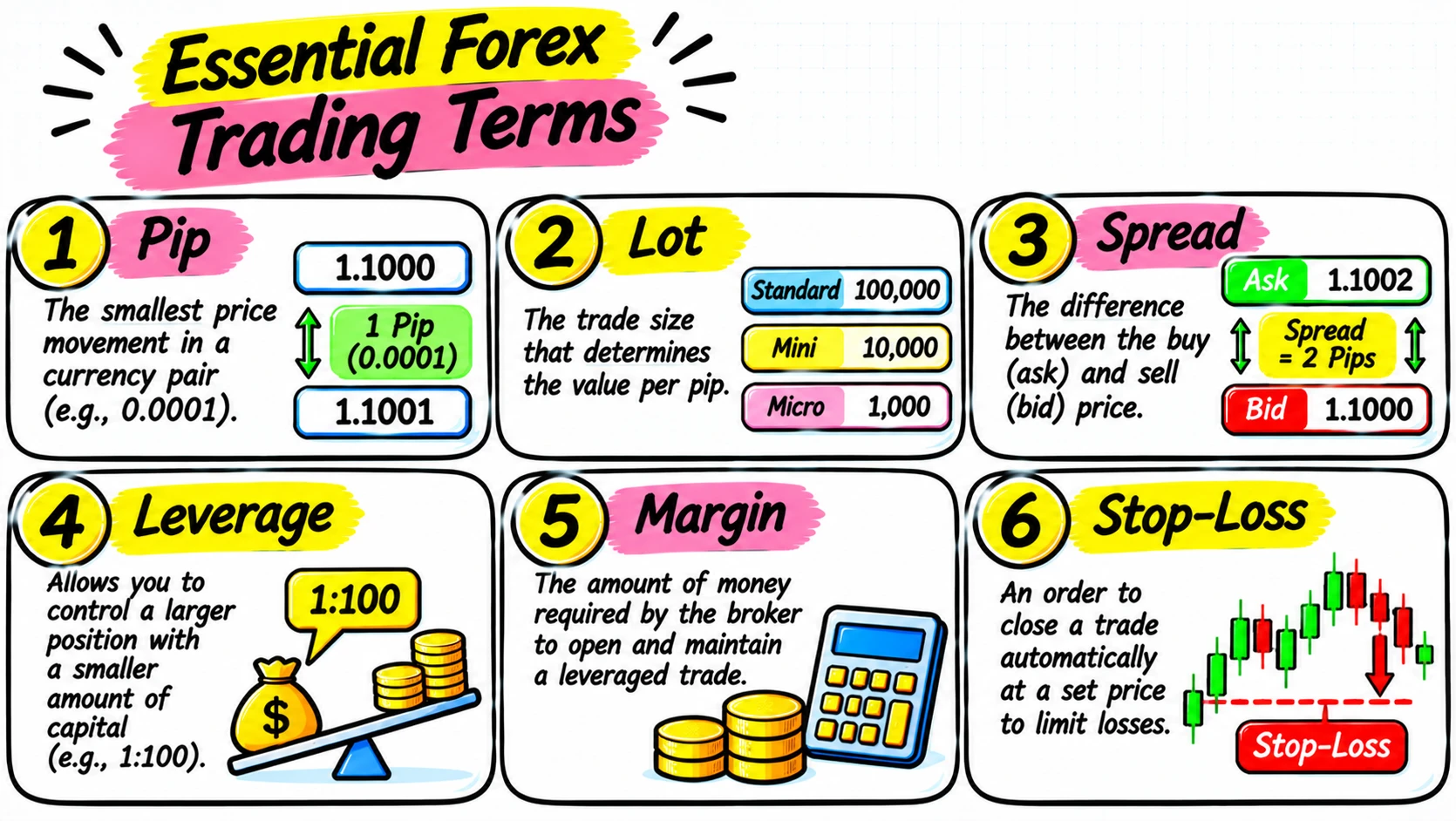
Before placing a forex trade, it is important to understand the terminology used by brokers and trading platforms.
1. Pip
A pip is a commonly used unit for measuring price movements in forex trading.
For most currency pairs, one pip equals 0.0001.
For example:
EUR/USD moves from 1.1000 to 1.1001.
That is a movement of one pip.
For many Japanese yen pairs, one pip is 0.01.
2. Lot Size
A lot represents the amount of currency being traded.
Common forex lot sizes include:
| Lot Type | Currency Units |
|---|---|
| Standard lot | 100,000 |
| Mini lot | 10,000 |
| Micro lot | 1,000 |
| Nano lot | 100 |
Not all brokers support every lot size, and contract specifications can vary.
For EUR/USD in a USD-denominated account, the approximate pip values are:
-
Standard lot: $10 per pip.
-
Mini lot: $1 per pip.
-
Micro lot: $0.10 per pip.
These values are examples and are not universal across all currency pairs.
3. Spread
The spread is the difference between the buying price (ask) and selling price (bid).
For example:
-
EUR/USD bid price: 1.1000.
-
EUR/USD ask price: 1.1002.
The spread is 0.0002, or 2 pips.
Spreads represent one component of trading costs.
Some brokers also charge commissions.
4. Leverage
Leverage allows traders to control a larger position using a smaller amount of capital.
For example, with 1:100 leverage, a trader may be able to control a $10,000 position using approximately $100 of margin, depending on the broker's rules.
However, leverage magnifies both potential profits and potential losses relative to the capital committed.
High leverage can cause substantial losses and rapid account liquidation.
5. Margin
Margin is the amount of money a broker requires to open and maintain a leveraged trading position.
Margin is not a fee. It is collateral allocated to support the position.
6. Stop-Loss
A stop-loss is an order designed to close a position when the market reaches a specified price.
Traders use stop-loss orders to help control potential losses.
However, stop-loss execution is not guaranteed at the requested price during market gaps or extreme volatility.
7. Take-Profit
A take-profit order is designed to close a position when a specified profit target is reached.
It allows traders to define potential exit levels in advance.
8. Swap or Rollover
Swap refers to the financing adjustment that may apply when certain forex positions are held overnight.
Depending on the currency pair, interest rate differences, broker pricing, and position direction, a trader may pay or receive an adjustment.
Forex Market Trading Sessions
The forex market generally operates 24 hours a day, five days a week.
Trading activity is commonly divided into four major sessions.
| Session | Major Financial Center |
|---|---|
| Sydney | Australia |
| Tokyo | Japan |
| London | United Kingdom |
| New York | United States |
The exact opening and closing times can shift due to daylight saving time.
Different sessions have different levels of trading activity.
For example, EUR/USD often experiences substantial liquidity during the overlap between the London and New York sessions.
However, high liquidity does not eliminate market risk.
What Moves Forex Prices?
Forex prices change because of supply and demand for currencies.
Several factors can influence these movements.
1. Interest Rates
Central banks influence interest rates through monetary policy.
Higher interest rates can sometimes attract demand for a currency, particularly when compared with interest rates in other economies.
However, currency movements also depend on expectations and broader economic conditions.
2. Inflation
Inflation measures changes in the general price level of goods and services.
Unexpected inflation reports can affect currency markets by changing expectations about central bank policy.
3. Employment Data
Employment reports provide information about economic activity and labor market conditions.
For example, the US Nonfarm Payrolls report can create significant volatility in USD currency pairs.
4. Economic Growth
Gross Domestic Product (GDP) measures the value of goods and services produced within an economy.
Economic growth expectations can influence investor demand for a country's currency.
5. Geopolitical Events
Political developments, international conflicts, trade policies, and economic uncertainty can affect currency demand.
6. Market Sentiment
Market sentiment reflects the overall positioning or expectations of market participants.
Traders sometimes use sentiment data to identify crowded positioning and potential changes in market behavior.
You can explore live retail positioning through the TraderSentiments Forex Sentiment Dashboard.
Basic Forex Trading Strategies for Beginners
There are many different ways to analyze forex markets.
Beginners should focus on understanding a few simple approaches before experimenting with more complex strategies.
1. Trend-Following Trading
Trend-following traders attempt to trade in the direction of an established market trend.
For example:
-
Buy during an uptrend.
-
Sell during a downtrend.
-
Use moving averages or market structure to identify direction.
However, trends can reverse unexpectedly.
2. Support and Resistance Trading
Support and resistance are price areas where buying or selling pressure has previously appeared.
Traders may monitor these levels for potential reactions.
For example, if EUR/USD repeatedly bounces from a support area, traders may look for a bullish confirmation signal near that zone.
Support and resistance levels can fail, so risk management remains important.
3. Breakout Trading
Breakout trading involves identifying price movements beyond established support or resistance.
For example, a trader might buy after an H1 candle closes above a well-defined resistance level.
However, false breakouts can occur when price quickly returns to the previous trading range.
4. Moving Average Trading
Moving averages smooth historical price data and help traders identify market direction.
Common indicators include:
-
20-period moving average.
-
50-period moving average.
-
200-period moving average.
Some traders use moving average crossovers as potential trading signals.
However, moving averages are lagging indicators and can produce false signals in ranging markets.
5. Smart Money Concepts Trading
Smart Money Concepts (SMC) is a price action framework focused on market structure, liquidity, and potential trading zones.
Common concepts include:
-
Break of Structure (BOS).
-
Change of Character (CHoCH).
-
Liquidity sweeps.
-
Order blocks.
-
Fair Value Gaps (FVG).
Learn more in our Smart Money Concepts Trading Guide.
These concepts can help structure market analysis, but they do not guarantee successful trades.
How to Start Forex Trading: Step by Step
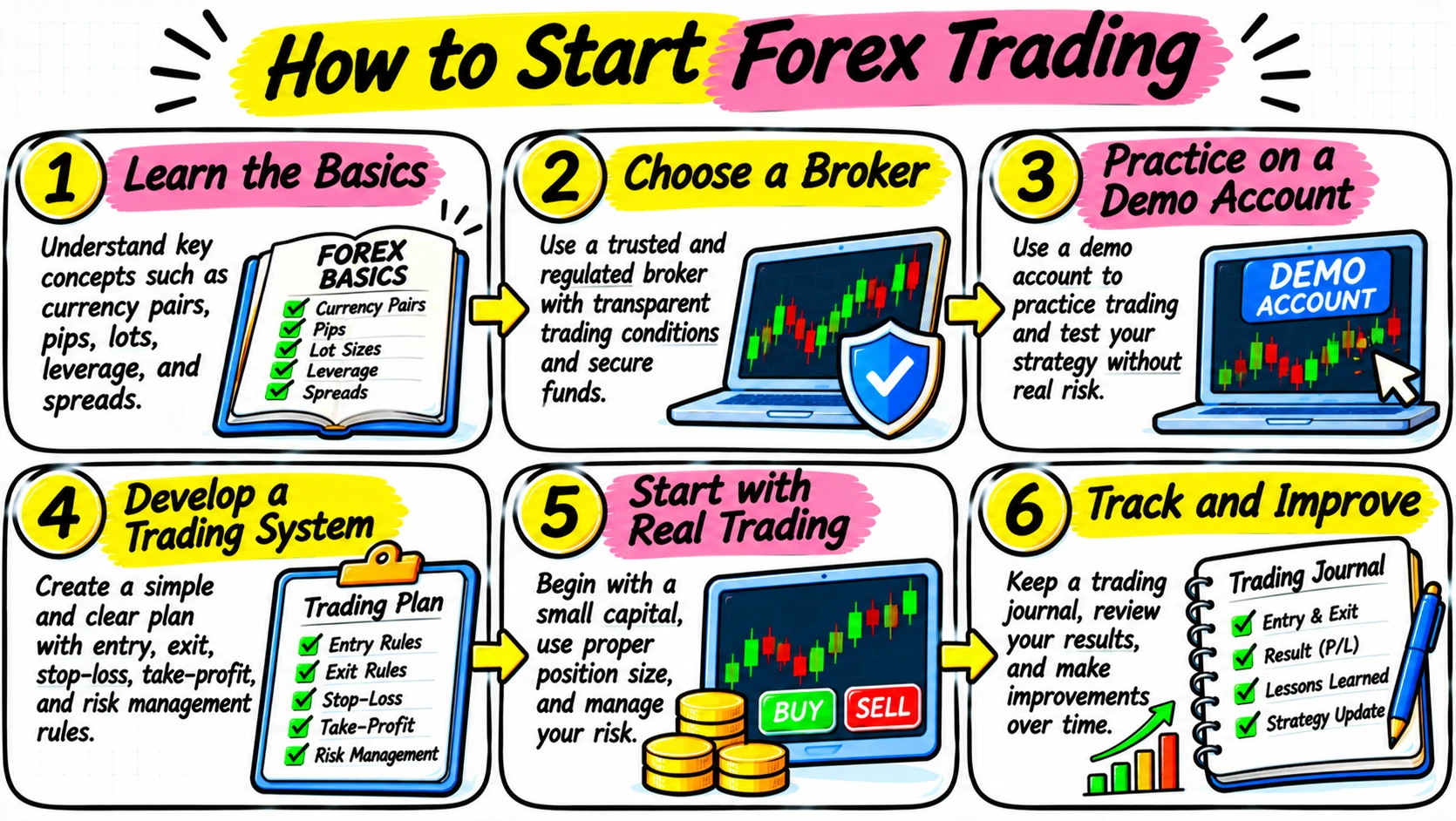
If you're new to forex trading, a structured learning process can help you avoid common mistakes.
Step 1: Learn the Basics
Understand currency pairs, pips, spreads, lots, leverage, and margin before opening a trade.
Step 2: Choose a Regulated Broker
Research a broker's regulatory status, trading conditions, costs, and withdrawal procedures.
Verify regulatory claims directly with the relevant financial regulator.
Step 3: Open a Demo Account
A demo account allows you to practice trading using simulated funds.
It can help you learn how a trading platform works without risking real capital.
However, demo trading may not fully reflect live execution conditions or emotional pressures.
Step 4: Choose a Trading Platform
Popular forex trading platforms include MetaTrader 4 and MetaTrader 5.
These platforms offer charts, technical indicators, order management, and automated trading capabilities.
Step 5: Develop a Trading System
A trading system defines the rules used to enter, manage, and exit positions.
It should include:
-
Market selection.
-
Trading timeframe.
-
Entry conditions.
-
Stop-loss placement.
-
Take-profit rules.
-
Position sizing.
-
Risk limits.
Read our Trading System Guide to learn how structured trading rules work.
Step 6: Practice Risk Management
Decide how much account equity you are prepared to risk on each trade.
Some traders use conservative risk allocations such as 0.5% or 1% per trade.
The appropriate amount depends on individual circumstances and strategy characteristics.
Step 7: Track Your Trading Results
Maintain a trading journal to record:
-
Entry and exit prices.
-
Trade direction.
-
Stop-loss and take-profit levels.
-
Position size.
-
Profit or loss.
-
Reason for entering.
-
Mistakes and lessons learned.
A trading journal can help identify recurring patterns in trading behavior.
Forex Risk Management Basics
Risk management is one of the most important parts of forex trading.
Even a strategy with a relatively high win rate can experience significant losses when position sizes are too large.
Risk Only What You Can Afford to Lose
Forex trading involves substantial financial risk.
Avoid trading with money needed for essential expenses or financial obligations.
Use Appropriate Position Sizes
Position sizing should be based on account equity, stop-loss distance, and the amount of risk you are willing to accept.
For example:
-
Account equity: $1,000.
-
Planned risk: 1%.
-
Maximum planned loss: $10.
The trader should calculate the position size so that the intended stop-loss corresponds to approximately $10 of risk, including relevant trading costs.
Actual losses may exceed this amount because of slippage or market gaps.
Avoid Excessive Leverage
High leverage increases the sensitivity of account equity to relatively small price movements.
Beginners should understand margin requirements and potential liquidation risks before using leverage.
Use a Trading Plan
A trading plan helps define when to enter, exit, and avoid trades.
It can also reduce impulsive decisions during volatile market conditions.
Understand Risk-to-Reward Ratio
Risk-to-reward ratio compares potential losses with potential profits.
For example:
-
Planned risk: $50.
-
Potential reward: $100.
-
Risk-to-reward ratio: 1:2.
A favorable risk-to-reward ratio does not guarantee profitability because trading outcomes depend on win rate, costs, and execution.
How to Use Forex Sentiment Analysis
Forex sentiment analysis examines how market participants are positioned or how they feel about future price movements.
Retail sentiment indicators commonly display the percentage of traders holding long and short positions.
For example:
-
75% of sampled retail traders are long EUR/USD.
-
25% are short EUR/USD.
This indicates that the sampled retail positioning is heavily tilted toward buying.
Some traders interpret extreme retail positioning from a contrarian perspective.
However, sentiment readings alone cannot reliably predict price reversals.
You can explore market positioning through the TraderSentiments Live Forex Sentiment Dashboard.
You can also compare major currencies using the Currency Strength Meter.
These tools may provide additional context alongside technical and fundamental analysis.
Common Forex Trading Mistakes Beginners Should Avoid
1. Trading Without a Plan
Entering positions randomly makes it difficult to measure performance and manage risk.
2. Using Too Much Leverage
Excessive leverage can quickly amplify losses.
3. Ignoring Stop-Loss Orders
Trading without a predefined exit plan can expose an account to substantial losses.
4. Overtrading
Opening too many positions can increase transaction costs and overall exposure.
5. Revenge Trading
Trying to recover losses immediately after a losing trade can lead to impulsive decisions.
6. Following Unverified Trading Signals
Trading signals from social media or unverified providers may not be based on reliable analysis.
7. Expecting Guaranteed Profits
No forex strategy, indicator, or trading system can guarantee profits.
Is Forex Trading Profitable for Beginners?
Forex trading can produce profits, but it also carries significant risks.
Many retail traders lose money, particularly when trading leveraged products.
Profitability depends on factors such as:
-
Trading strategy.
-
Risk management.
-
Market conditions.
-
Trading costs.
-
Execution quality.
-
Discipline.
-
Experience.
Beginners should focus on learning, practicing, and evaluating their results rather than expecting immediate income.
Forex trading should not be treated as a guaranteed source of earnings.
Frequently Asked Questions About Forex Trading Basics
What is forex trading in simple terms?
Forex trading involves buying one currency and selling another to speculate on changes in exchange rates.
How much money do I need to start forex trading?
Minimum deposits vary by broker and account type. However, the minimum deposit should not be confused with the amount of capital needed to manage trading risks appropriately.
Can I start forex trading with $100?
Some brokers allow accounts to be opened with $100 or less. However, a small account can be particularly vulnerable to trading costs, leverage, and percentage losses.
What is a pip in forex trading?
A pip is a standard unit used to measure currency price movements. For most forex pairs, one pip equals 0.0001.
What is leverage in forex trading?
Leverage allows traders to control a larger market position using a smaller amount of margin. It magnifies both potential profits and losses.
What is the best currency pair for beginners?
Major currency pairs such as EUR/USD are often studied by beginners because they generally have high liquidity and relatively competitive spreads. However, no currency pair is risk-free.
What is the best forex trading strategy for beginners?
There is no universally best strategy. Beginners may benefit from learning simple approaches such as trend-following, support and resistance, or basic breakout trading before exploring more complex methods.
Is forex trading gambling?
Forex trading involves uncertainty and financial risk. Without a structured approach, it can resemble speculative gambling. A trading system and risk management can improve discipline, but they do not eliminate the possibility of losses.
Can I trade forex without indicators?
Yes. Some traders use price action, support and resistance, and market structure without relying heavily on technical indicators.
Is forex trading open 24 hours?
The forex market generally operates 24 hours a day from Monday to Friday, with brief differences in broker schedules and market holidays.
Conclusion
Understanding the forex trading basics is essential before participating in the foreign exchange market.
Beginners should first learn how currency pairs, pips, lot sizes, spreads, leverage, and margin work.
The next step is developing a structured trading system, practicing on a demo account, and learning how to manage risk.
Forex trading offers opportunities to participate in global currency markets, but it also involves substantial uncertainty and potential losses.
Successful learning begins with realistic expectations, disciplined risk management, and continuous education.
For additional market analysis, explore the TraderSentiments Forex Sentiment Dashboard and Currency Strength Meter.
Visit TraderSentiments.com for more forex education, market sentiment tools, and trading insights.
Disclaimer: This article is for educational and informational purposes only and does not constitute financial or investment advice. Forex and leveraged trading involve substantial risk and may result in significant financial losses.
Write Your Comment