

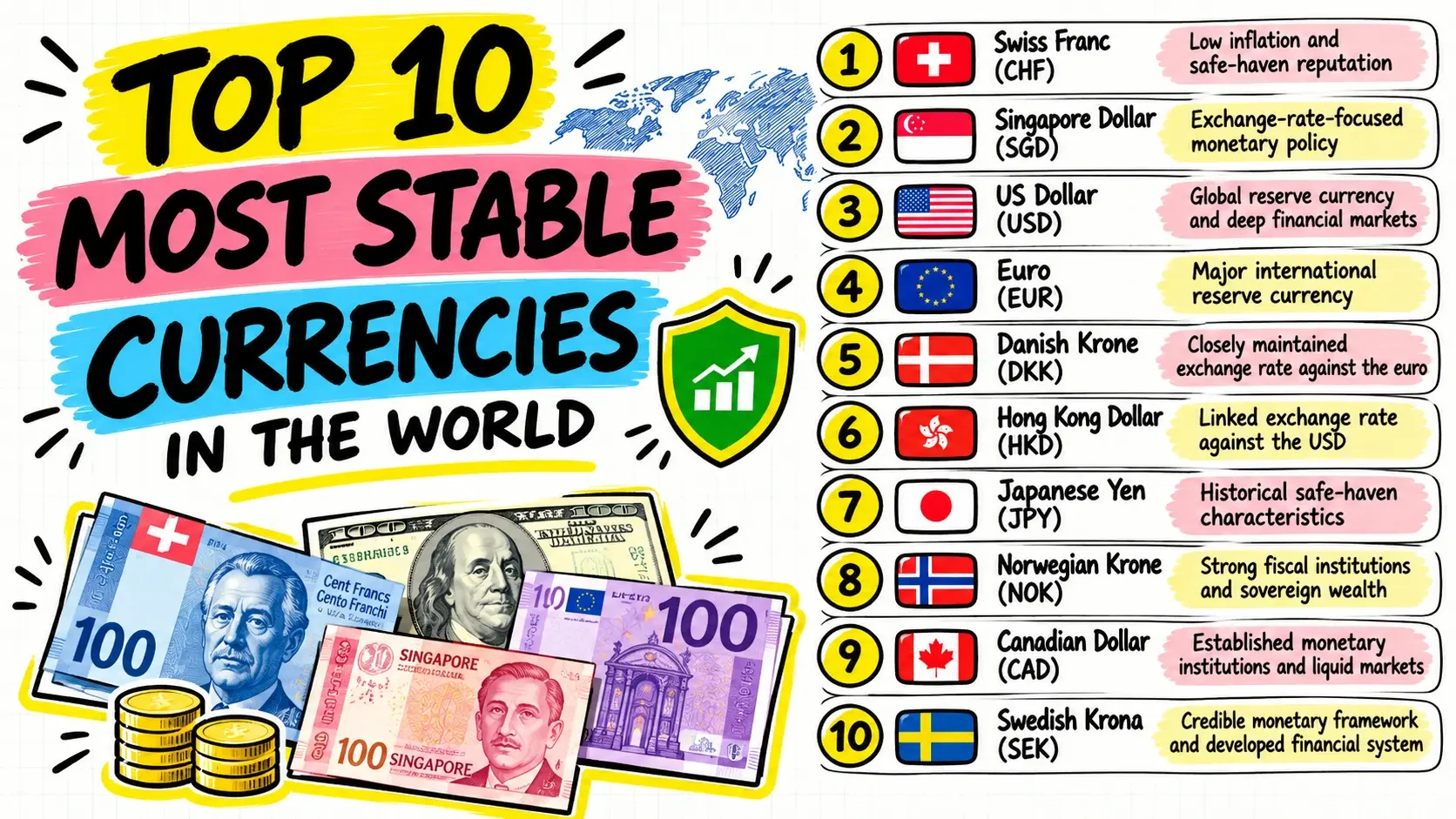
The Swiss franc (CHF) is widely regarded as one of the most stable currencies in the world, supported by Switzerland's low inflation, strong financial institutions, and reputation as a safe haven.
Other currencies associated with monetary stability include the Singapore dollar, US dollar, euro, and Danish krone.
However, currency stability does not necessarily mean having the highest exchange rate. A stable currency generally maintains relatively consistent purchasing power, benefits from credible monetary policies, and avoids excessive fluctuations over time.
In this guide, we explore 10 currencies known for different forms of stability, what supports their value, and why stability matters in forex trading.
What Is the Most Stable Currency in the World?

The Swiss franc is a leading candidate when evaluating long-term purchasing-power preservation and safe-haven characteristics.
Switzerland has maintained relatively low inflation over extended periods, while its financial system and monetary institutions have supported international confidence in the franc.
During periods of global uncertainty, investors have historically increased demand for Swiss francs, sometimes causing the currency to appreciate against other major currencies.
However, there is no universally accepted ranking of the world's most stable currencies. The answer depends on whether stability is measured by inflation, exchange-rate volatility, long-term purchasing power, or performance during financial crises.
Top 10 Most Stable Currencies in 2026
The following currencies are selected for their monetary credibility, international importance, exchange-rate arrangements, or historical stability.
1. Swiss Franc (CHF) — Switzerland
Key Stability Characteristic: Low inflation and safe-haven reputation.
The Swiss franc is known for low inflation, monetary credibility, and its safe-haven reputation. Investors often seek CHF during global financial uncertainty, although this demand can cause significant exchange-rate movements.
2. Singapore Dollar (SGD) — Singapore
Key Stability Characteristic: Exchange-rate-focused monetary policy.
The Singapore dollar benefits from a monetary policy framework that manages its exchange rate against a basket of currencies. This approach helps Singapore manage imported inflation and maintain price stability.
3. US Dollar (USD) — United States
Key Stability Characteristic: Global reserve currency and deep financial markets.
The US dollar is the world's dominant reserve currency and plays a central role in international trade and financial markets. Its liquidity and global acceptance support demand, although its exchange rate can fluctuate significantly.
4. Euro (EUR) — Euro Area
Key Stability Characteristic: Major international reserve currency.
The euro is one of the world's most important international currencies. It benefits from the euro area's large economy, established financial markets, and the European Central Bank's monetary framework.
5. Danish Krone (DKK) — Denmark
Key Stability Characteristic: Closely maintained exchange rate against the euro.
The Danish krone maintains a closely managed exchange rate against the euro. Denmark's fixed-exchange-rate policy helps limit fluctuations between DKK and EUR, although its value against other currencies can change.
6. Hong Kong Dollar (HKD) — Hong Kong
Key Stability Characteristic: Linked exchange rate against the USD.
The Hong Kong dollar operates under a linked exchange-rate system that maintains its value within a defined band against the US dollar. This provides relative USD/HKD exchange-rate stability.
7. Japanese Yen (JPY) — Japan
Key Stability Characteristic: Historical safe-haven characteristics.
The Japanese yen has historically acted as a safe-haven currency during financial market stress. However, interest-rate differences and global capital flows can produce substantial fluctuations in JPY exchange rates.
8. Norwegian Krone (NOK) — Norway
Key Stability Characteristic: Strong fiscal institutions and sovereign wealth.
The Norwegian krone is supported by Norway's strong fiscal institutions and substantial sovereign wealth. Nevertheless, oil prices and global risk sentiment can make NOK relatively volatile.
9. Canadian Dollar (CAD) — Canada
Key Stability Characteristic: Established monetary institutions and liquid markets.
The Canadian dollar benefits from established financial institutions, a credible central bank, and liquid currency markets. Commodity prices, interest rates, and trade with the United States can influence its movements.
10. Swedish Krona (SEK) — Sweden
Key Stability Characteristic: Credible monetary framework and developed financial system.
The Swedish krona is backed by a developed economy and established monetary institutions. However, SEK is a floating currency and can experience significant exchange-rate movements during global uncertainty.
Note: This is an editorial selection, not a statistically verified ranking from most to least stable. Some currencies have stable exchange-rate arrangements, while others can experience substantial market volatility.
What Makes a Currency Stable?
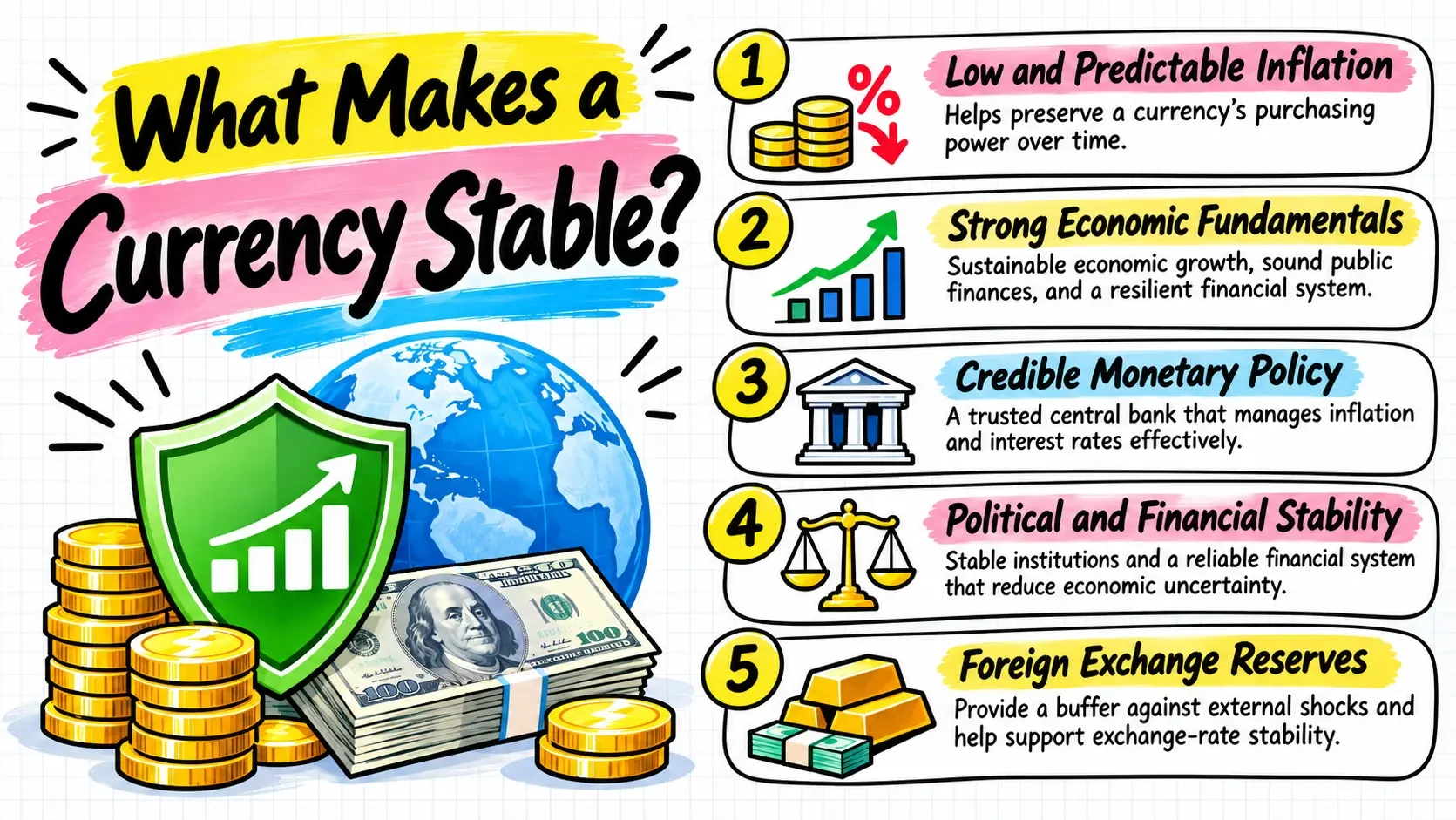
Several economic factors contribute to currency stability.
1. Low and Predictable Inflation
Low inflation helps preserve a currency's purchasing power and supports confidence among consumers, businesses, and investors.
2. Strong Economic Fundamentals
Sustainable economic growth, sound public finances, and a resilient financial system can support long-term currency confidence.
3. Credible Monetary Policy
Central banks influence currency conditions through interest rates, inflation management, and monetary policy decisions.
4. Political and Financial Stability
Predictable institutions and a reliable financial system can reduce uncertainty and encourage international investment.
5. Foreign Exchange Reserves
Foreign exchange reserves can help central banks manage external shocks and support certain exchange-rate arrangements.
Stable Currency vs. Strong Currency: What's the Difference?
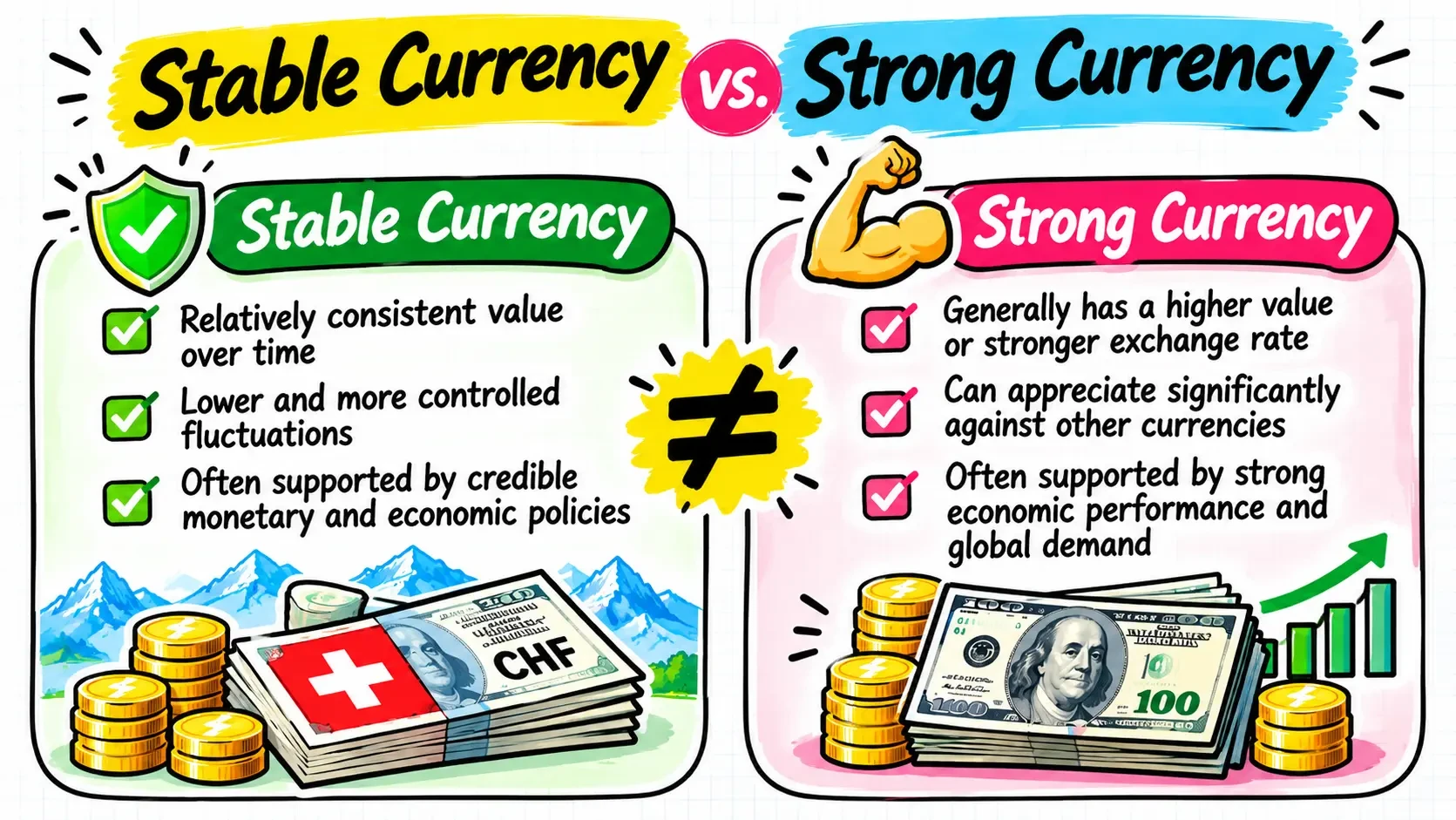
A stable currency and a strong currency are not necessarily the same.
A stable currency experiences relatively limited fluctuations under a specified measure, such as its exchange rate against another currency or its domestic purchasing power.
A strong currency may refer to one with a high nominal exchange rate or one that has appreciated against other currencies.
For example, the Hong Kong dollar maintains a narrow exchange-rate band against the US dollar, while the Swiss franc can appreciate considerably during periods of global uncertainty.
Both may be associated with stability, but for different reasons.
How Do Stable Currencies Affect Forex Trading?
Currency stability plays an important role in forex market behavior.
Stable monetary frameworks can improve predictability, but they do not eliminate trading risks.
Forex traders should consider:
-
Volatility: Even traditionally stable currencies can experience sudden price movements.
-
Liquidity: Major currency pairs generally have deeper markets and more competitive trading conditions.
-
Interest rates: Central bank decisions can influence exchange rates and capital flows.
-
Safe-haven demand: Some currencies attract investment during periods of uncertainty.
-
Exchange-rate policies: Pegged and managed currencies behave differently from freely floating currencies.
For example, USD/CHF may react to global risk sentiment, while EUR/DKK is influenced by Denmark's exchange-rate policy.
Understanding these differences helps traders interpret market conditions and manage risk.
Is the Swiss Franc Safer Than the US Dollar?
The Swiss franc and US dollar serve different roles in the global financial system.
The Swiss franc is particularly associated with long-term purchasing-power preservation and safe-haven demand.
The US dollar benefits from exceptional international liquidity, widespread use in trade, and its dominant role in global foreign exchange reserves.
Neither currency is risk-free. Their relative performance depends on inflation, interest rates, market conditions, and the period being evaluated.
Frequently Asked Questions
What is the most stable currency in the world in 2026?
The Swiss franc is widely considered one of the strongest examples of long-term monetary stability, although no single currency leads under every stability measure.
Is the Swiss franc more stable than the US dollar?
The Swiss franc has a strong history of low inflation and purchasing-power preservation, while the US dollar offers exceptional liquidity and global acceptance. The comparison depends on how stability is measured.
Is the Singapore dollar a stable currency?
Yes, the Singapore dollar is associated with a credible exchange-rate-focused monetary framework that helps manage inflation and external economic pressures.
What is the most stable currency in Asia?
The Singapore dollar is a notable candidate because of Singapore's monetary framework. The Hong Kong dollar also has a highly stable bilateral exchange rate against the US dollar due to its linked exchange-rate system.
Is the most expensive currency also the most stable?
No. A currency's high nominal exchange rate does not automatically mean it has low inflation or limited exchange-rate volatility.
Can stable currencies lose value?
Yes. All currencies can depreciate or lose purchasing power. Even safe-haven currencies may experience significant fluctuations during changing market conditions.
Conclusion
The Swiss franc, Singapore dollar, US dollar, and euro are among the currencies most frequently associated with monetary credibility and international confidence.
Other currencies, such as the Danish krone and Hong Kong dollar, demonstrate stability through their exchange-rate arrangements.
However, currency stability should always be evaluated using clearly defined measures rather than nominal exchange rates alone.
For forex traders, understanding monetary policy, inflation, liquidity, and exchange-rate volatility is essential when assessing currency movements.
Explore forex market insights, currency sentiment, and trading tools at TraderSentiments.com.
Disclaimer: This article is for educational purposes only and does not constitute financial or investment advice.
Write Your Comment