

Trend trading (trend following) is a strategy built around following the market’s dominant direction and staying in the trade long enough to capture a meaningful part of the move. This guide explains how trend traders identify trends, time entries, manage risk, and avoid common mistakes.
Trend trading is popular because it aligns with a simple market truth: strong moves tend to continue longer than most traders expect. The challenge is not finding trends—it’s following them without jumping out too early or getting shaken out by normal pullbacks.
A good trend trading plan focuses on three things: (1) confirming direction on a higher timeframe, (2) entering with a clear invalidation level, and (3) managing risk so you can stay in the trade as the trend develops.
Trend trading explained
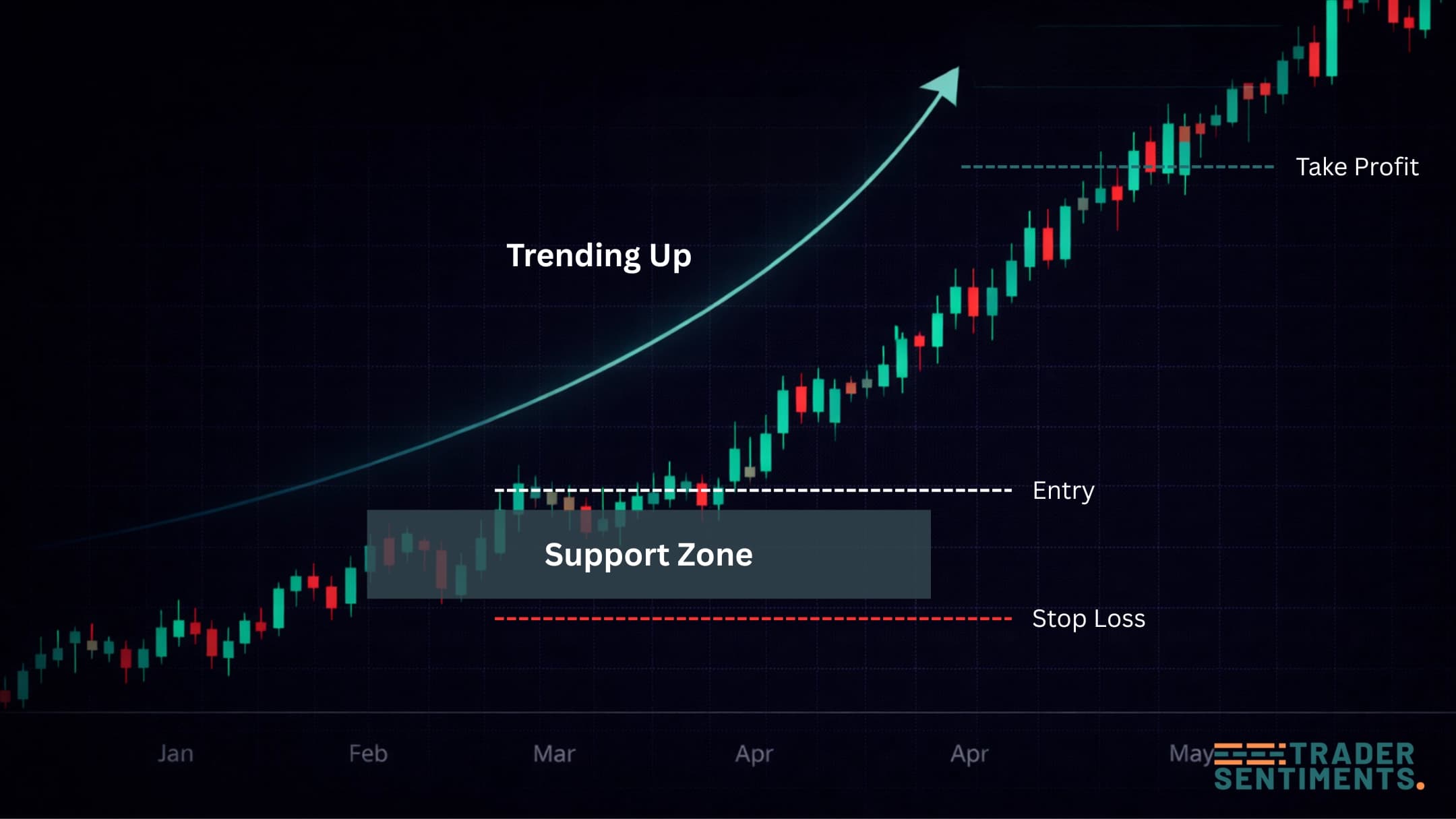
Trend trading means trading in the direction of the market’s dominant move. In an uptrend, traders focus on buy setups; in a downtrend, traders focus on sell setups. The idea is to avoid fighting the larger flow and instead ride it.
Most trend traders do not need perfect entries. What matters more is entering at a place where the trend is still valid and your risk is defined. Once in, the goal becomes staying in the trade while the trend continues, and exiting when the trend clearly breaks.
Key characteristics
- Direction-first: filter setups by trend direction before thinking about entries.
- Pullbacks are normal: expect retracements and plan risk to survive them.
- Trade management matters: trailing, partials, and structure exits are common.
- Fewer revenge trades: when rules are clear, you trade less with more discipline.
- Entering too late after an extended move (poor RR).
- Putting stops too tight (getting stopped by normal pullbacks).
- Taking profit too early because of fear.
- Switching bias too fast after one pullback candle.
How to identify a trend
Trend identification should be simple and repeatable. Many traders use market structure: higher highs/higher lows for uptrends and lower highs/lower lows for downtrends.
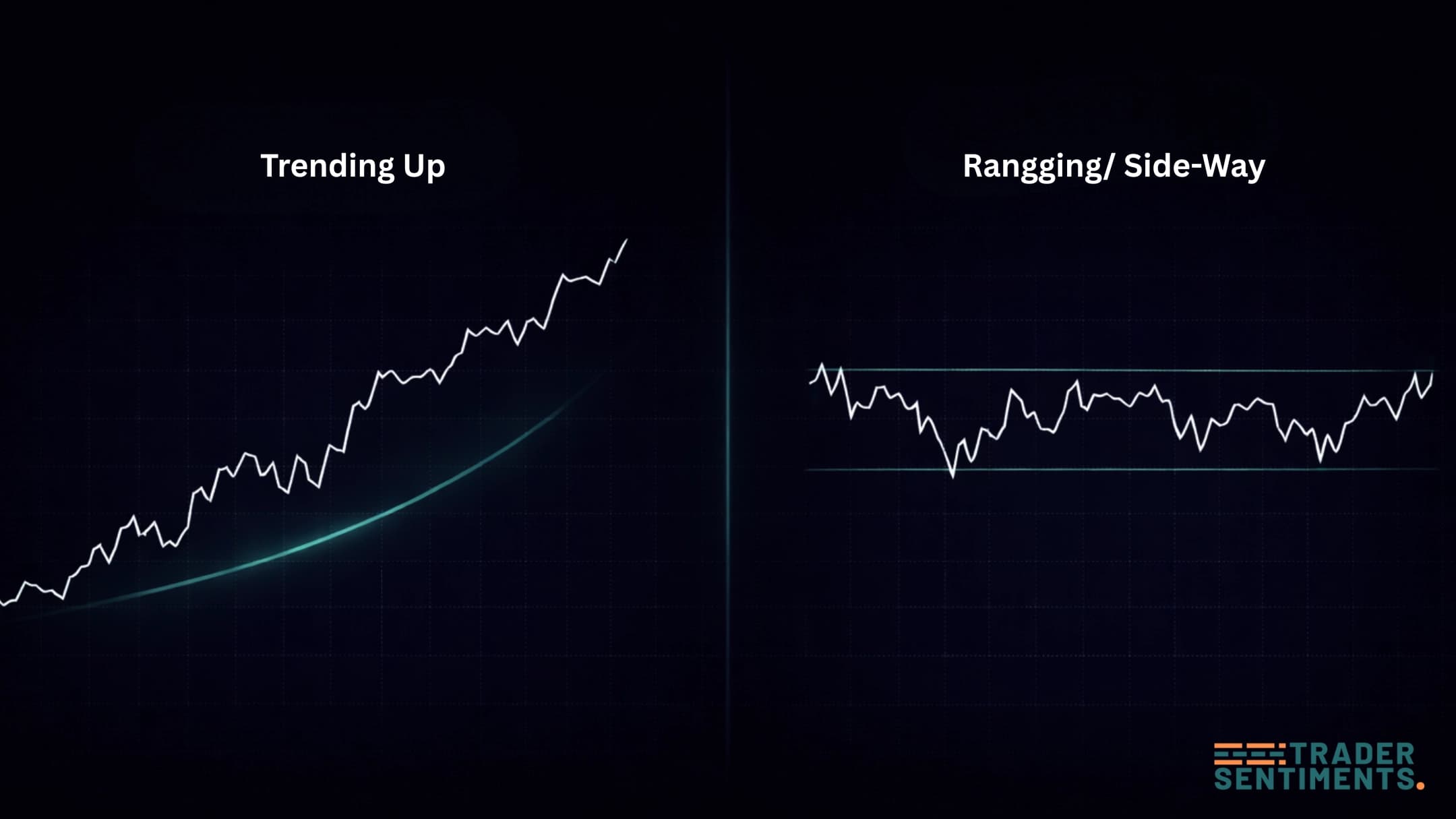
- Uptrend: HH + HL pattern holds.
- Downtrend: LL + LH pattern holds.
- Trend break: key HL/LH fails and holds beyond.
- Price above rising MA = bullish bias.
- Price below falling MA = bearish bias.
- Use slope + structure for stronger confirmation.
Avoid mixing too many trend filters. Pick one method and apply it consistently.
Entry and exit techniques
Trend traders typically enter in one of three ways: (1) pullback entries, (2) breakout and retest entries, or (3) momentum confirmation entries. Each has trade-offs between early entry and higher confirmation.
- Pullback entry: enter when price returns to prior support/resistance in trend direction.
- Breakout + retest: enter after breakout, then retest + hold.
- Momentum shift: enter after structure shifts back to trend direction.
Exits should be rule-based. Many trend traders trail behind structure (e.g., last swing low in an uptrend) or take partial profit at key levels and trail the remainder.
Risk management approach
Trends include pullbacks, consolidations, and volatility spikes. Most traders risk a fixed percentage per trade (e.g., 0.5%–1%) and place stops beyond structure invalidation (not emotion).
- Risk a fixed % per trade, not a fixed lot size.
- Stops go where your thesis breaks (structure-based).
- Avoid overexposure to the same driver (USD / risk sentiment).
- Don’t widen stops after entry.
Building a trend trading strategy
A solid trend strategy is a simple system you can repeat. Keep rules consistent: same trend filter, same entry model, same risk, and the same management rules.
- Select timeframe: H4/D1 for trend + H1/H4 for entries.
- Define trend: structure or MA slope + structure.
- Choose entry model: pullback, breakout+retest, or momentum shift.
- Define invalidation: where the trend is no longer valid.
- Trade management: trailing behind structure or partials + trail.
- Trend: D1 bullish = only buy setups.
- Entry: H4 pullback into prior support + bullish confirmation candle.
- Stop: below the last H4 swing low.
- TP: partial at next key level; trail rest behind H4 structure.
- Risk: 0.5% per trade.