

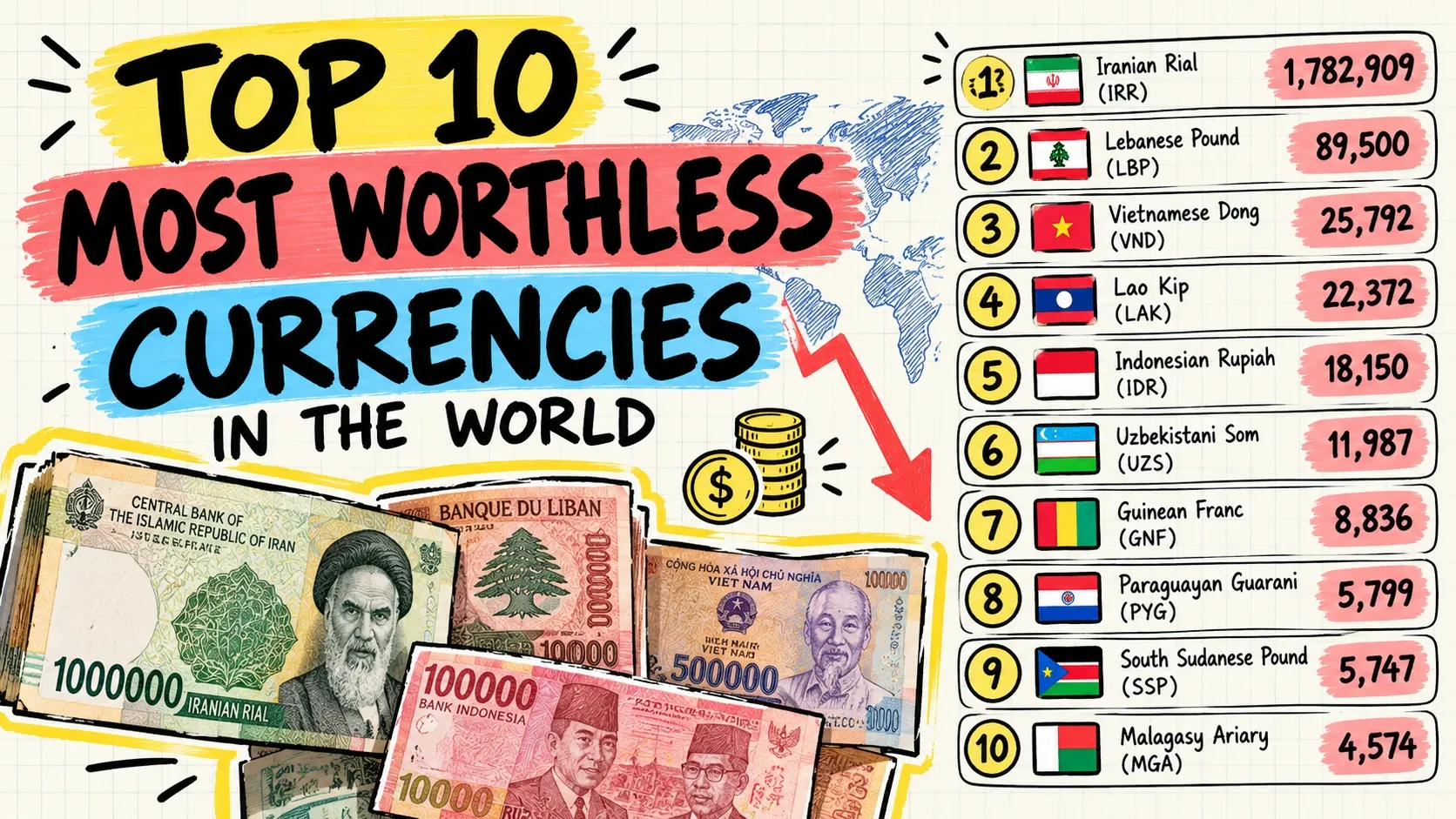
The Iranian rial (IRR) is among the world's least valuable currencies in 2026 when measured by the number of units required to purchase one US dollar. Other currencies with very low nominal values include the Lebanese pound, Vietnamese dong, Lao kip, and Indonesian rupiah.
However, a currency's low exchange-rate value does not necessarily indicate a weak economy. Some currencies have large denominations because of historical inflation or monetary policies, while others have experienced substantial depreciation due to economic instability.
In this guide, we explore the 10 most worthless currencies in the world, explain why their values are low, and examine what currency weakness means for the global forex market.
What Is the Most Worthless Currency in the World?
The Iranian rial is the lowest-valued currency in our October 2026 comparison, based on an indicative market-rate snapshot.
On October 30, 2026, one US dollar was equivalent to approximately 1.78 million Iranian rials in the referenced exchange-rate dataset.
Iran's exchange-rate system is complicated by the existence of different official and market rates. Consequently, the rial's position can vary depending on which rate is used.
The Lebanese pound is another particularly low-valued currency, reflecting the effects of Lebanon's prolonged financial and banking crisis.
Top 10 Most Worthless Currencies in 2026
The following table ranks currencies according to how many units are needed to purchase one US dollar.
1. Iranian Rial (IRR) — Iran
1 USD ≈ 1,782,909 IRR
The Iranian rial is among the world's lowest-valued currencies due to high inflation, economic sanctions, and financial instability. Multiple exchange rates and currency restrictions also affect its value.
2. Lebanese Pound (LBP) — Lebanon
1 USD ≈ 89,500 LBP
The Lebanese pound has lost significant value following the country's financial crisis. Banking problems, inflation, and economic instability have weakened confidence in the currency.
3. Vietnamese Dong (VND) — Vietnam
1 USD ≈ 25,792 VND
The Vietnamese dong has a low nominal value against the US dollar, largely reflecting its monetary history. However, this does not necessarily indicate a weak economy.
4. Lao Kip (LAK) — Laos
1 USD ≈ 22,372 LAK
The Lao kip faces pressure from inflation, external debt, and foreign currency demand. Depreciation makes imported goods more expensive and affects purchasing power.
5. Indonesian Rupiah (IDR) — Indonesia
1 USD ≈ 18,150 IDR
The Indonesian rupiah has a low nominal exchange rate, influenced by monetary history, global interest rates, and capital flows. Its low unit value does not necessarily reflect economic weakness.
6. Uzbekistani Som (UZS) — Uzbekistan
1 USD ≈ 11,987 UZS
The Uzbekistani som's low nominal value reflects historical inflation and monetary developments. Economic reforms and international trade also influence its exchange rate.
7. Guinean Franc (GNF) — Guinea
1 USD ≈ 8,836 GNF
The Guinean franc is affected by inflation, economic conditions, and international trade. Despite Guinea's mineral resources, its currency maintains a relatively low nominal value.
8. Paraguayan Guarani (PYG) — Paraguay
1 USD ≈ 5,799 PYG
The Paraguayan guarani has a low nominal exchange rate influenced by monetary history, agricultural exports, and regional trade. This does not necessarily indicate economic instability.
9. South Sudanese Pound (SSP) — South Sudan
1 USD ≈ 5,747 SSP
The South Sudanese pound has faced significant depreciation due to inflation, political instability, foreign currency shortages, and dependence on oil revenues.
10. Malagasy Ariary (MGA) — Madagascar
1 USD ≈ 4,574 MGA
The Malagasy ariary has a relatively low nominal value influenced by inflation, trade conditions, and foreign currency demand. Its exchange rate does not alone determine economic strength.
Note: Exchange rates are approximate figures from the October 30, 2026 comparison and may vary depending on the data provider and exchange-rate market. Rankings are based on nominal currency units per US dollar, not overall economic strength.
Why Are Some Currencies Worth So Little?

Several economic factors can contribute to a low currency value.
Inflation
When prices rise persistently, a currency's domestic purchasing power declines.
High inflation can also weaken confidence in the currency and increase demand for foreign alternatives.
Currency Depreciation
Currency depreciation occurs when a currency loses value relative to another currency.
For example, if the USD exchange rate moves from 15,000 to 17,000 units of a local currency, more local currency is required to purchase one dollar.
Economic and Financial Instability
Banking crises, debt difficulties, and uncertainty can reduce confidence in a currency.
Businesses and investors may respond by increasing their holdings of foreign currencies.
Monetary Policy
Central banks influence currency conditions through interest rates, liquidity management, foreign-exchange intervention, and other monetary tools.
However, the effectiveness of these policies depends on broader economic circumstances.
Historical Currency Denominations
Some currencies have large numerical denominations because of historical inflation or decisions not to redenominate.
This is why a currency trading at 20,000 units per dollar is not automatically weaker in economic terms than one trading at 100 units per dollar.
Does a Low Currency Value Mean a Weak Economy?
 Not necessarily.
A currency's nominal exchange rate tells us how much of one currency can be exchanged for another.
It does not directly measure economic growth, household income, productivity, or financial stability.
For example, both the Vietnamese dong and Indonesian rupiah have low nominal unit values, but their economic characteristics differ considerably from those of countries facing severe monetary crises.
To evaluate currency strength more meaningfully, analysts may examine inflation, exchange-rate trends, real effective exchange rates, foreign reserves, and economic fundamentals.
How Do Weak Currencies Affect Forex Trading?
Currencies experiencing depreciation may create trading opportunities, but they also introduce risks.
Traders should consider liquidity, spreads, volatility, and market accessibility.
Some low-valued currencies are not widely available through retail forex brokers. Others may be subject to exchange controls or significant differences between official and market exchange rates.
A currency with a low nominal value is not necessarily undervalued, and it should not be assumed that the currency will eventually recover.
Forex traders should assess market trends, economic indicators, and risk management before making trading decisions.
Can a Worthless Currency Recover Its Value?
Currencies can appreciate following improvements in economic conditions, monetary credibility, and market confidence.
Lower inflation, stronger foreign-exchange reserves, improved financial stability, and sustainable economic policies may support a currency over time.
Some countries also introduce currency redenomination, replacing old units with new units at a fixed conversion ratio.
However, redenomination does not automatically increase purchasing power or resolve underlying economic problems.
Frequently Asked Questions
What is the most worthless currency in the world in 2026?
The Iranian rial ranks as the lowest-valued currency in the October 30, 2026 comparison used in this article. Rankings may differ depending on whether official or market exchange rates are used.
Is the Vietnamese dong a worthless currency?
The Vietnamese dong has a low nominal value against the US dollar, but that does not mean it has no purchasing power or that Vietnam has a weak economy.
Why is the Indonesian rupiah so low?
The rupiah's numerical exchange-rate value reflects its monetary history and exchange-rate developments. Global financial conditions, interest rates, and capital flows also influence its value.
Is the Iranian rial weaker than the Lebanese pound?
At the indicative market rates used in this comparison, the Iranian rial has a lower nominal unit value. Some published rankings place the Lebanese pound first because they use a different Iranian exchange rate.
Can you trade the world's weakest currencies?
Some emerging-market currencies are available through banks, specialist foreign-exchange providers, or certain brokers. However, accessibility, liquidity, trading costs, and restrictions vary significantly.
What is the difference between a weak currency and a worthless currency?
A weak currency generally refers to one that has a low value or is depreciating relative to another currency. A truly worthless currency would have little or no practical purchasing power. The phrase "most worthless currency" is commonly used in searches to describe currencies with very low nominal exchange-rate values.
Conclusion
The world's lowest-valued currencies in 2026 include the Iranian rial, Lebanese pound, Vietnamese dong, Lao kip, and Indonesian rupiah.
While these currencies require large numbers of units to purchase one US dollar, their economic circumstances vary considerably.
For forex traders and currency analysts, understanding inflation, monetary policy, exchange-rate movements, and market liquidity is more valuable than focusing on nominal currency rankings alone.
Explore additional forex market insights and trading sentiment analysis at TraderSentiments.com.
Write Your Comment